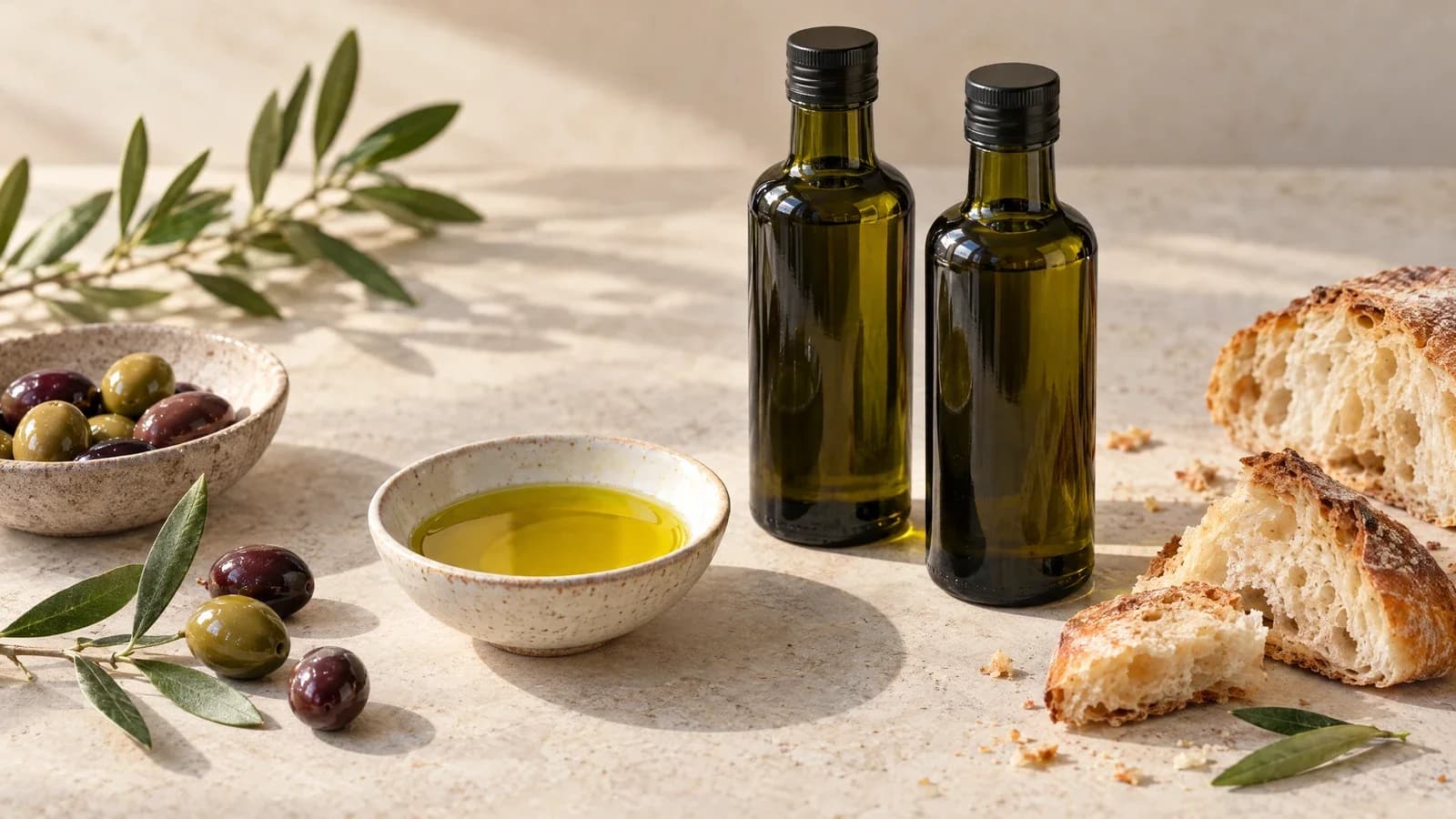
Quick answer: Choose a Palestinian olive oil gift set that tells you who made the oil, where the olives were grown and pressed, and when they were harvested. If it includes several bottles, look for clear information about what makes each one different. Dark glass or an opaque tin helps protect oil from light, while a harvest date is more useful for freshness than a best-before date alone. 1 2
What makes a tasting set worth choosing?
A good set makes comparison possible, not just presentation. Two or three smaller bottles can be a useful format if a seller offers them, but the number of bottles matters less than the information attached to each one. Look for named producers, a stated harvest or crop year, and a clear description of the difference between the oils. That difference might be the cultivar, growing area, harvest, or producer; do not assume it from the box design.
“Palestinian olive oil” is not a single flavor profile. A study of Nabali oils sampled from Nablus, Salfit, Qalqilya, and Jenin examined samples from different production areas. The researchers also note that factors such as cultivar, climate, fruit maturity, and farming practices can affect virgin olive oil. The study is not a flavor map for every Palestinian region, so treat named origins as useful traceability information—not a promise that every bottle from one place tastes alike. 3
A seller should distinguish where the olives were grown from where the oil was milled, bottled, or packed. UC Davis recommends checking where olive oil was made rather than relying on the packaging location. If a listing says only “Palestinian-inspired,” “Mediterranean,” or “packed in Palestine,” ask what that means for the olives themselves before treating it as proof of origin. 1
Read the label before the ribbon
Start with the producer or cooperative name. A useful product page should let you learn who grew, pressed, or marketed the oil, rather than relying only on a flag, olive-branch illustration, or broad heritage language. A named cooperative, farm, or mill gives you somewhere to look for more information.
Next, look for a harvest date. A “best before” date is not the same thing: olive oil is a fresh agricultural product, and its flavor can fade over time. UC Davis recommends looking for the harvest date and choosing a recent harvest when possible. The same guidance says to check the place where the oil was made, not just where it was packaged. 1
A certification can add useful context when the certificate and the product are clearly identified. For example, Fairtrade’s gift guide describes Zaytoun extra virgin olive oil as grown by family farmers in Palestine and explains the role of West Bank olive-growing cooperatives in reaching export markets. That is a documented example, not a claim that any particular set is currently in stock or that a certification alone proves every detail on another seller’s label. 4
Finally, choose protective packaging over a clear bottle displayed in a bright gift box. UC Davis explains that color does not tell you whether an oil is good, while dark glass, tin, and bag-in-box formats protect oil better from light or air than clear plastic. Keep the unopened gift somewhere cool and dark, and encourage the recipient to close the cap promptly and use the bottle within a reasonable time after opening. 2
Pick a set for the person receiving it
For someone new to tasting, choose a set whose maker provides straightforward tasting notes and explains how to use each oil. A recipient who already enjoys olive oil may appreciate harvest and cultivar details, a named producer, and a set that makes the differences between bottles easy to compare. Sensory descriptions are most helpful when they are specific and attached to a particular oil, rather than presented as a fixed description of all Palestinian oil.
If the box combines oil with other pantry goods, check whether the oil is still the focus. A sampler of oils is best for comparing olive oils; a mixed Palestinian pantry box can be a lovely broader gift, but it serves a different purpose. Our Palestinian pantry guide covers olive oil alongside za’atar, sumac, grains, and other ingredients, while the thoughtful Palestinian gifts guide gives broader advice on provenance and choosing gifts.
A simple way to taste the bottles
Pour a small amount of each oil into a clean, neutral cup. Smell first, then taste a little on its own before trying it with bread or vegetables. The International Olive Council’s standards include sensory assessment of virgin olive oil, and UC Davis describes fruitiness, bitterness, and pungency as positive attributes of extra virgin olive oil. Notice which notes you enjoy and how strongly they appear; bitterness or a peppery finish does not automatically mean the oil is defective. 1 5
Do not judge the oil by its color. UC Davis notes that color is affected by factors including variety, region, climate, fruit maturity, and processing, and is not a reliable quality test. A tasting card should help explain the oil; it should not be a substitute for a clear label or a recent harvest date. 2
For a Palestinian table pairing, try the oils with warm bread or use one to finish a dish. The Palestinian olive harvest article explores the season and its traditions, while our Musakhan guide shows one familiar way olive oil brings flavor to a meal.
A quick buyer’s checklist
Before ordering, check that the listing names the producer; states where the olives were grown and where the oil was made; gives a harvest date or crop year; describes each bottle in a multi-oil set; and uses packaging that protects the oil from light. Confirm bottle sizes, price, delivery region, shipping fees, and current stock directly with the seller, because those details can change and are not established by a general guide.
A thoughtful Palestinian olive oil gift set does not need elaborate claims. The strongest choice is the one that lets the giver and recipient trace the oil back to a real producer, understand what is in each bottle, and taste the oils with curiosity.