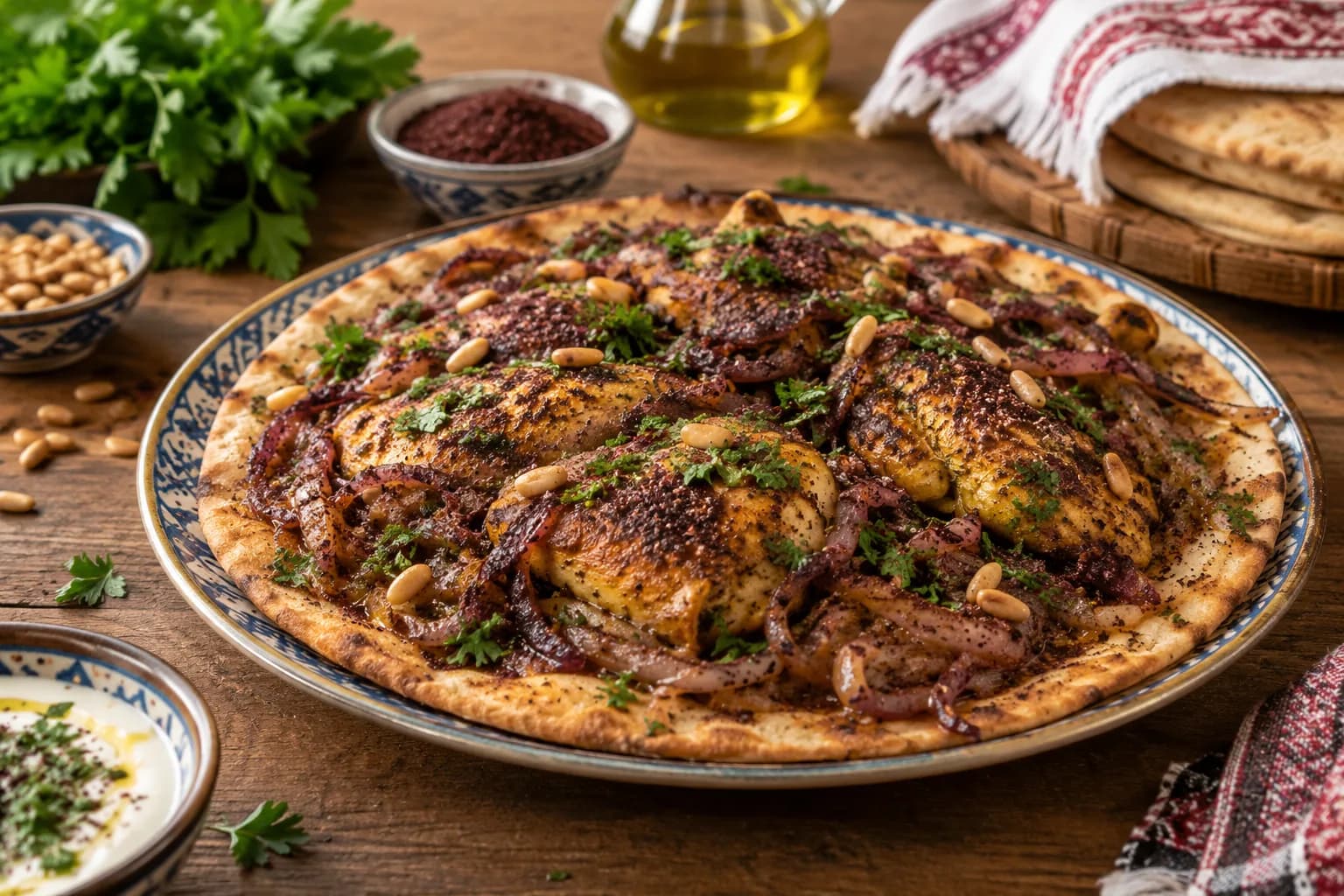
What is Palestinian musakhan, and how is it made? Musakhan (مسخّن) is a Palestinian dish built around roasted chicken, onions softened in olive oil and sumac, and bread—traditionally taboon (طابون)—that catches the seasoned oil and onion juices. The ingredients are served together, often on a platter, so each piece of bread carries part of the meal.
There is no single household formula. In the recipes and descriptions reviewed here, the stable idea is the relationship between bread, onion, oil, sumac and chicken; the amounts, added spices and assembly vary. This guide explains that structure without presenting one family’s proportions as a national standard.
1. What Musakhan is—and what holds it together
Musakhan is not simply roast chicken accompanied by bread. The bread is part of the dish: it forms a base for the onions and chicken and takes up some of the olive oil and cooking juices. In Wafa’s Palestine in a Dish recipe, and in the description from Travel Palestine, the central combination is bread, sumac-seasoned onions, olive oil and chicken.
The dish’s name is often translated as “heated” or “something that is heated.” Both sources use a version of that translation. It is a useful gloss, not evidence for a particular origin story or date.
2. Why bread, onions, olive oil and sumac matter
Each part has a practical role in the finished dish:
- Bread gives the dish its base. Taboon bread is the traditional choice in the accounts consulted. A sturdier flatbread can hold the onion layer and chicken, though a substitute should be described as a substitute rather than another name for taboon.
- Onions make a substantial layer. They are cooked until soft with olive oil and sumac, rather than added only as a garnish. As they cook down, their sweetness balances sumac’s tartness.
- Olive oil carries the flavor. It cooks with the onions and seasons the bread beneath them. It is part of the dish’s structure, not merely a finishing drizzle.
- Sumac brings tartness and color. Ground summaq (سماق) gives the onion mixture its sharp, tangy note. It is a defining flavor in the recipe accounts reviewed here.
- Chicken makes the dish a meal. The sources describe roasted chicken placed over the bread and onions. Some versions add toasted nuts; those are a finish, not the core structure.
For a broader discussion of olive oil and sumac beyond this dish, see the site’s Palestinian Pantry guide.
3. How the dish comes together
The method is best understood in stages, not as one fixed recipe:
- Cook the chicken. Roast seasoned chicken until cooked through. The recipes consulted roast the chicken separately before assembly.
- Soften the onions. Cook sliced or chopped onions in olive oil until soft, then season with sumac. Individual recipes use different amounts and may add other seasonings.
- Prepare the bread. Set taboon bread on a serving platter or warm it as the chosen method directs.
- Build the layers. Spread the onions and their oil over the bread, then place the roasted chicken on top. Some accounts briefly heat the bread and onion layer before adding the chicken; others describe heating the assembled dish.
Those assembly differences matter: the sources do not establish a single required oven temperature, timing, or order for the final warming. Proportions vary, too. For that reason, this is a qualitative guide, not a tested recipe with measurements.
4. Variation without a single “authentic” formula
Published recipes differ in onion type, chicken cuts, seasoning and how the layers are warmed. Wafa’s recipe gives one cook’s version; the Mediterranean Dish recipe explicitly identifies itself as an adaptation of Reem Kassis’s The Palestinian Table. Those are useful examples, not a complete survey of Palestinian home cooking.
Some individual recipes include warm spices such as allspice or cinnamon. They should not be read as compulsory ingredients: the sources do not establish a universal spice blend for Musakhan. The familiar core remains the bread, olive-oil-softened onions, sumac and chicken.
5. Musakhan and the olive harvest
Some food accounts connect Musakhan with the olive harvest and freshly pressed oil. Wafa’s recipe describes a fall-season association; the Mediterranean Dish’s Kassis-adapted recipe also connects the dish to harvest while noting it is eaten year-round. Travel Palestine describes it as a dish that celebrates fresh-pressed olive oil.
Taken together, these sources support describing a seasonal association, not a rule that Musakhan must be made only in autumn or that every family follows the same harvest custom. The sources reviewed here do not establish a single historical origin for that association.
6. Serving and practical details
Musakhan is commonly presented as bread topped with onions and chicken; the sources describe eating it by hand. A platter lets diners take bread with some of the topping, rather than separating the bread from the rest of the dish. Some recipes add toasted pine nuts or almonds. The Travel Palestine account also mentions broth-based soup, salad or yogurt alongside; these are serving suggestions, not requirements.
A few practical points follow from the dish’s structure:
- Choose bread sturdy enough to support the topping.
- Cook the onions until soft so they spread over the bread.
- Taste the sumac-onion mixture as you go; the desired balance depends on the sumac and the cook’s preference.
- Expect the bread beneath the onions to take on oil and juices. Musakhan is not meant to keep every part crisp.
7. A respectful way to describe the dish
Call it Palestinian Musakhan, and distinguish a particular recipe or family method from a universal standard. “Authentic” can obscure the variation that the sources themselves show. When sharing a version, name its source or describe it as one approach; do not turn an individual recipe into a claim about every Palestinian table.
What to Read Next
- For background on olive oil and sumac, continue to the Palestinian Pantry guide.
- For a different chicken dish built around rice and layered vegetables, read Authentic Palestinian Maqluba.
- For a handmade grain served in Palestinian meals, see Palestinian Maftoul.
Sources
- Wafa, “Chicken Musakhan,” Palestine in a Dish.
- Reem Kassis, The Palestinian Table (Phaidon, 2017; ISBN 978-0714874968). Its recipe is adapted, with permission, in “Musakhan: Sumac Chicken and Caramelized Onion Flatbread,” The Mediterranean Dish.
- “Musakhan,” Travel Palestine.