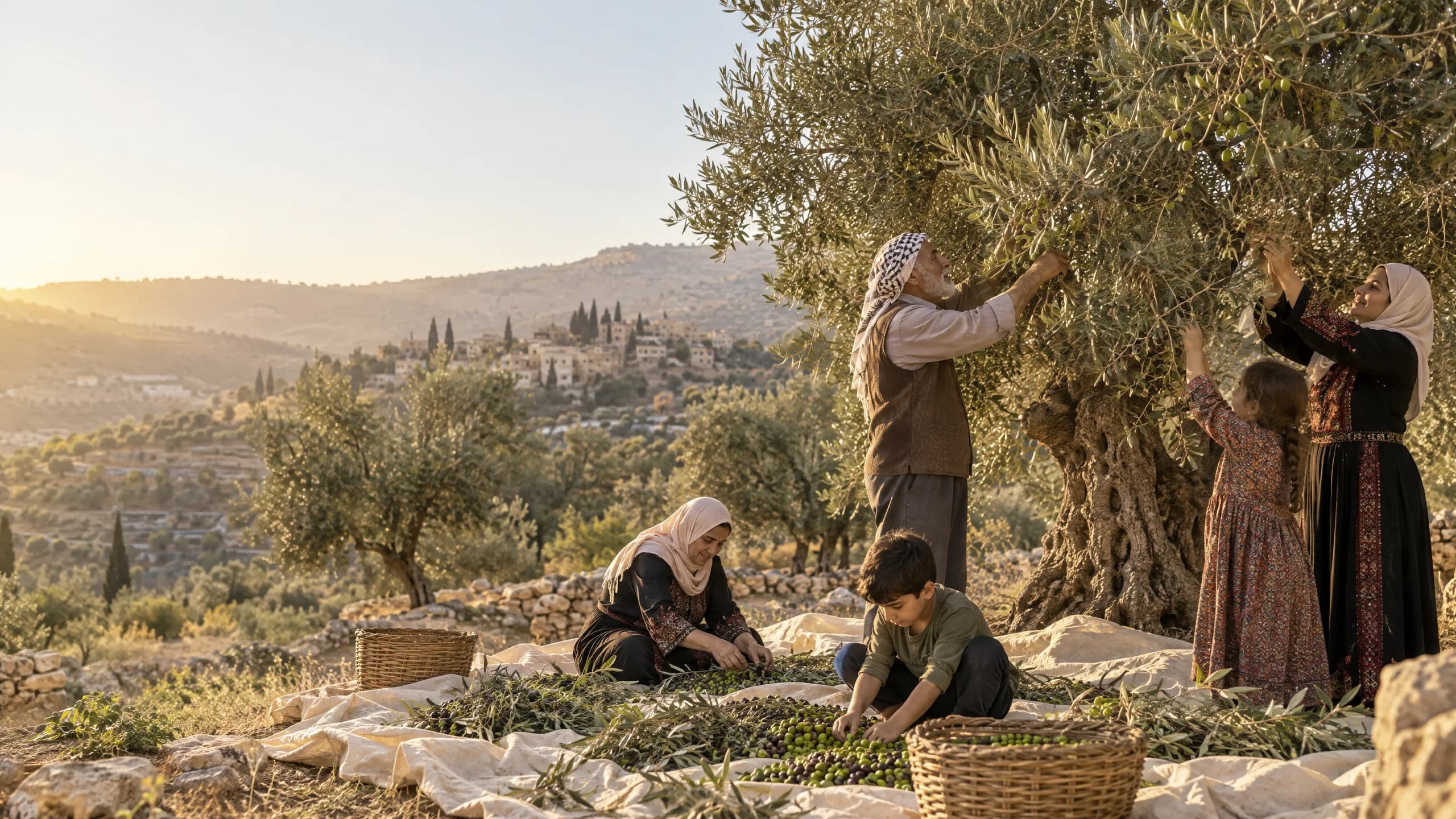
Every autumn, Palestinian families leave their offices, classrooms, and kitchens for the olive groves. The season is known as Mawsim al-Zaytoun: the olive season. It is agricultural work, a family reunion, and a community gathering at the same time.
Grandparents explain when the fruit is ready. Children collect olives from the sheets beneath the trees. Neighbours move from one family’s grove to the next. At the end of the season, the year’s oil returns home in metal tins, glass bottles, or traditional clay jars. What is harvested is not only fruit. It is food, income, memory, and a relationship with the land.
When does the olive harvest begin?
The harvest generally begins in October and continues into November, although the exact timing varies with altitude, weather, the variety of olive, and local agricultural practice. In many communities, preparation begins in September. Families clean their tools, repair ladders, prepare sheets and sacks, and watch for the first autumn rains.
These rains are sometimes called talat al-matar. They soften the soil and wash the summer dust from the trees. Palestinian proverbs also associate them with barakeh, or blessing, for the harvest and the year ahead. The first rain is therefore both a practical moment and a cultural marker. 1
There is no single harvest date for every grove. A Palestinian Ministry of Agriculture announcement may establish an official opening date for a particular season, but farmers still judge the readiness of their own trees. The fruit’s colour, firmness, and the desired style of oil all influence when picking begins.
Al-Ouneh: the custom of harvesting together
At the heart of Mawsim al-Zaytoun is al-ouneh (العونة), a tradition of mutual help. Relatives and neighbours gather to harvest one family’s trees, then move on to another family’s land. No one treats the work as a commercial contract. The favour is returned during the same season, creating a practical network of goodwill across the village. 2
The work is shared in ways that often reflect experience and age, although every family organises the harvest differently. Strong climbers and experienced pickers reach the higher branches. Others work from the ground, gather the fruit from the sheets, sort leaves and twigs, or prepare food. Children may collect olives that fall outside the sheets, a task sometimes called al-talqeet. The important principle is participation: each person contributes what they can.
In some Palestinian villages, the harvest once shaped the school calendar. Children were given time away from classes to help their families, and schools sometimes organised visits to olive groves. Public harvest events in Bethlehem and elsewhere continue to combine picking with music, dance, food, and traditional handicrafts. 3
From branch to sack: how the olives are picked
A harvest day often begins at dawn. Large cloths or tarps are spread beneath the tree to catch the falling fruit. Pickers then remove the olives by hand, moving along the branches and working from the upper parts of the tree downwards. Hand-picking is slower, but it is gentle on the tree and helps protect the buds that will produce the following year’s crop.
Ladders are used for high branches. Some farmers also use long poles to loosen the fruit, though striking the branches too aggressively can damage new growth. Once the olives are gathered, leaves and small twigs are removed. The fruit is placed in sacks or crates and taken to the mill as soon as possible. Delays, heat, or bruising can reduce the quality of the oil.
Olive trees can also produce a heavy crop one year and a lighter crop the next. This pattern, known as alternate bearing, is influenced by climate, soil, pruning, and the care available to the grove. 1
Food in the groves: al-Zuwwadeh
Harvest days can last from early morning until sunset, so families bring a packed field meal known in some communities as al-zuwwadeh. The food is simple, portable, and designed for sharing. It may include taboon bread, olive oil and za’atar, tomatoes, cucumbers, cheese, labneh, and tea flavoured with sage.
A meal beneath an olive tree is part of the social life of the season. People rest together, exchange news, tell stories about earlier harvests, and make space for relatives who have travelled from the city or abroad. The food connects the work in the grove with the household waiting at home.
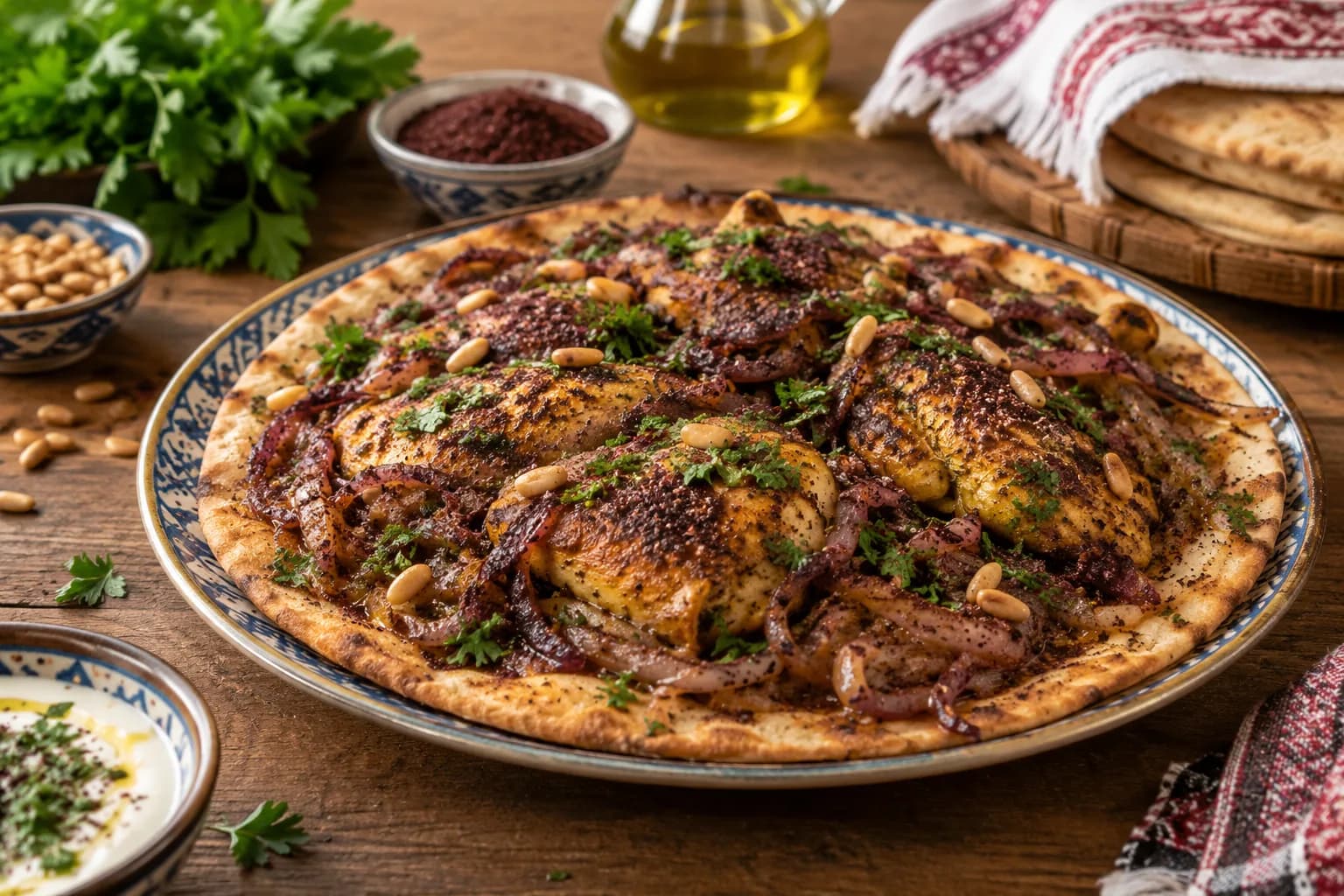
When the new oil returns from the mill, some families celebrate by preparing musakhan: taboon bread soaked in olive oil and topped with onions, sumac, and chicken. The dish is not the only food associated with the season, but its combination of bread, oil, onions, and warm spices makes it a memorable expression of the first press.
Folk songs and proverbs of the olive harvest
The olive groves have traditionally been places of conversation, humour, and song. Singing helps people keep a shared rhythm while they work, but it also gives the harvest an emotional language. A verse can praise the land, tease a neighbour, welcome a relative, express longing, or turn a long day into a collective celebration.
‘Ala Dal‘ouna: an invitation to help
‘Ala Dal‘ouna is a well-known Levantine folk-song form heard in Palestinian celebrations and, in some communities, associated with seasonal work. The word dal‘ouna is commonly understood as an appeal to come together or help. Its repeated opening creates a call-and-response feeling: one voice begins, and the group answers or joins the refrain.
One olive-related line is often rendered in English as:
‘Ala dal‘ouna, ‘ala dal‘ouna
Zaytoun bladi ajmal ma yakouna
“Come to the dal‘ouna, come to the dal‘ouna;
the olives of my homeland are the most beautiful there can be.” 2
The meaning is larger than praise for the fruit. The song connects beauty to belonging. “My homeland” is not an abstract idea; it is the grove, the familiar tree, the village path, and the people working together. The refrain also echoes the social principle of al-ouneh: the harvest becomes easier when people answer one another’s call.
‘Ataba: longing, wit, and the voice of the individual
‘Ataba is another traditional sung-poetry form found across the Levant. It is often built from short poetic lines that use wordplay, repetition, and a closing phrase with a different meaning. During a harvest gathering, an ‘ataba can carry a personal feeling inside a communal day: homesickness, love, grief, pride in the village, or a humorous observation about the work.
Its role in the olive grove is therefore different from a simple work chant. The steady movement of picking creates a setting in which one person can improvise a verse and others can answer. The poem becomes a conversation carried by melody. The subject may be the tree in front of the singer, but the deeper themes are memory, absence, patience, and return.
Proverbs about oil as household security
Palestinian sayings about wheat and oil describe the two foods as the foundation of a secure home. One commonly cited expression is:
Al-zayt ‘imad al-bayt — “Oil is the pillar of the house.” 2
The “pillar” in this proverb is both literal and symbolic. Olive oil is a daily ingredient, a source of calories, and a product that can be stored for the year. It also represents the labour of the family and the reliability of the land. A home with oil has something essential to cook with, serve to guests, and share with relatives.
Another saying joins wheat and oil:
Al-qamh w-al-zayt sab‘een fil-bayt — “Wheat and oil are seventy in the house.” 2
The number seventy is not meant as an exact household inventory. It intensifies the idea of abundance: wheat provides bread, while oil provides nourishment, flavour, and a means of preparing food. Together they stand for the basics that allow a family to endure the year.
A third expression is often translated as:
Kul zayt w-intah il-heit — “Eat oil and butt the wall.” 2
This humorous proverb turns olive oil into a sign of strength. To “butt the wall” is an exaggerated image of physical energy. The saying is playful, but it also reflects the reputation of olive oil as sustaining food for farmers who spend long hours outdoors.
What these words preserve
The songs and proverbs do not describe the harvest from a distance. They preserve the logic of the season: work is shared, the land is loved, food is saved for the year, and strength comes from both nourishment and community. Older family members often pass these expressions on together with recipes for curing olives and instructions for tasting or storing oil.
For that reason, the folklore of Mawsim al-Zaytoun should not be reduced to decoration. The words are a small oral archive. They remember how people worked, what they valued, and how a family understood its relationship with a tree that might outlive several generations.
From the bad to the modern mill
Before modern mills, olives were crushed in a bad (البدّ), a large round millstone turned on a flat stone base. Depending on the place and period, the stone could be pulled by a horse, mule, or camel. The crushed olive paste was placed in woven containers and pressed until the oil ran out. Remains of old presses survive in villages across Palestine, linking present-day production to a much older agricultural history.
Modern mills complete the process in a few hours. The olives are washed, crushed, and separated into oil, water, and solid residue. Families may still wait at the mill to taste the first oil on warm bread. Fresh oil can taste intensely green, bitter, or peppery, especially when the olives are harvested early.
The oil is stored in sealed tins or dark containers and kept away from heat and light. Some of it is reserved for the household. Some is shared with relatives in cities or abroad. Sending a tin of olive oil is both a practical gift and a way of sending a piece of the harvest home.
Olive varieties and the many uses of the tree
Palestine is home to several olive varieties. Nabali, also called Baladi or “local,” is widely used for both oil and table olives. Souri is valued for its strong oil, while other local varieties are associated with particular regions and growing conditions. The flavour of the final oil depends not only on the variety but also on the soil, the season, the maturity of the fruit, and the time between picking and pressing. 1
The same fruit can be used in different ways. Green olives may be cracked or slit and cured with water, salt, lemon, or chilli. Fully ripe black olives can be cured in salt. Olive oil is used in cooking and served with bread, za’atar, labneh, salads, and stews.
The tree continues to serve the household after pressing. Nablus is famous for its olive-oil soap. Olive wood is used in Bethlehem for ornaments, prayer beads, and other crafts. Pressed olive residue, known as jift, may be used as fuel in some traditional settings. 2
The terraces of Battir
The relationship between the olive tree and the land can be seen clearly in Battir, south-west of Jerusalem. UNESCO describes its cultural landscape as a system of agricultural valleys, stone terraces, olive trees, vines, and traditional irrigation channels. Water is distributed among families through an established rotation system.
The terraces are therefore more than a beautiful landscape. They are a record of shared agricultural knowledge. Their walls, paths, channels, and trees show how communities adapted steep land for cultivation and maintained it across generations. 4
Gaza’s olive groves
The olive harvest is often pictured through the terraced hills of the West Bank, but Gaza has its own longstanding olive culture. Before the current destruction, its groves were an important source of food, work, and oil. In 2019, Gaza produced an estimated 5,582 tonnes of olive oil, according to figures cited by Al Jazeera. 1
Harvesting in Gaza has also been a family occasion. Children and adults worked among the trees, families shared food, and the groves provided rare spaces for rest and gathering. Recent reporting, however, describes a devastating collapse. Reuters reported in October 2026 that Gaza agricultural authorities estimated only about 150,000 of the territory’s roughly two million olive trees were still standing, with projected production far below pre-war levels. These are time-sensitive estimates, but they convey the scale of the loss. 5
The destruction of a grove affects more than the coming harvest. It removes shade, income, food, family work, and a place where seasonal memory is renewed. For many Gazan families, preserving the names of dishes, songs, and harvesting practices has become part of preserving the tradition itself.
A season shaped by pressure
Across Palestine, the olive harvest is also shaped by restrictions on access to land, damage to trees, and violence against farmers. OCHA has described the annual harvest as a key economic, social, and cultural event and has reported that approximately 100,000 families depend to some extent on it. The UN Human Rights Office has likewise called the harvest an economic backbone for rural Palestinian communities. 6 7
These pressures do not replace the cultural meaning of the season, but they make it more urgent. To reach a grove, care for a tree, and bring its fruit to the press is to maintain a family’s connection with the land. Each intact tree represents years of work. Each harvest carries the memory of those who planted, pruned, picked, and shared its oil before.
Honouring the season from afar
People who are not in Palestine can still learn from and honour the season without treating it as a spectacle. They can cook a dish made with Palestinian olive oil, learn the meaning of words such as mawsim al-zaytoun, al-ouneh, al-zuwwadeh, and talqeet, and buy olive oil or olive-wood crafts from producers who clearly identify their origin and compensate makers fairly.
They can also treat olive oil as a living food rather than a souvenir: store it in a cool, dark place, keep it tightly sealed, and use it at the table where it belongs. The most respectful way to encounter the tradition is to understand the people, labour, and history behind the product.
Mawsim al-Zaytoun endures because it is practised. It lives in the hands that spread the sheets, the neighbours who return a day of help, the grandmothers who preserve recipes, and the children who learn to recognise the fruit. Every autumn, the harvest gathers those strands together. The olives become oil, but the season becomes memory, kinship, and continuity.
Frequently asked questions
When is the olive harvest in Palestine?
It usually takes place from October through November. The exact timing varies by region, altitude, weather, and olive variety. Preparations often begin in September after the first autumn rains.
What is al-ouneh?
Al-ouneh is a tradition of mutual help. Relatives and neighbours harvest one family’s olives together, then return the favour by helping the next family during the same season.
What is the most common Palestinian olive variety?
Nabali, also called Baladi (“local”), is one of the most widespread traditional varieties. It is used for both olive oil and table olives.
What food is associated with the olive harvest?
Families often eat simple field meals of bread, oil, za’atar, vegetables, cheese, and tea. Musakhan, made with bread, olive oil, onions, sumac, and chicken, is often prepared when the new oil comes home from the mill.
What is a bad?
A bad is a traditional olive press using a large millstone to crush the fruit before the paste is pressed for oil.