Quick answer: The Palestinian Hikaye is a traditional form of oral storytelling practised by women. Told in Palestinian dialects, these fictional tales explore family relationships, social expectations, and women’s lives. More than entertainment, the Hikaye is a form of cultural expression through which generations have shared language, imagination, and social memory. UNESCO inscribed it on the Representative List of the Intangible Cultural Heritage of Humanity in 2008.
1. What Is the Palestinian Hikaye?
The Palestinian Hikaye (الحكاية الفلسطينية) is an oral storytelling tradition practised by women and passed from one generation to another. Its stories are fictional, but the worlds they describe are closely connected to everyday life: family relationships, social expectations, personal choices, and the position of women within society.
The storyteller does more than remember a plot. She gives the story its character through her voice, the rhythm of her speech, emphasis, pauses, and changes in tone. A familiar tale can become an absorbing experience because of the way it is told and the way listeners respond.
UNESCO describes the Hikaye as a narrative expression that offers a view of society from women’s perspectives. Many stories explore tensions between duty and desire, revealing the expectations and contradictions that shape family and community life.
The Hikaye is therefore not simply a collection of old stories. It is a form of storytelling in which women interpret the world around them, sometimes through humour, imagination, exaggeration, and moral reflection.
2. A Storytelling Tradition Passed Between Generations
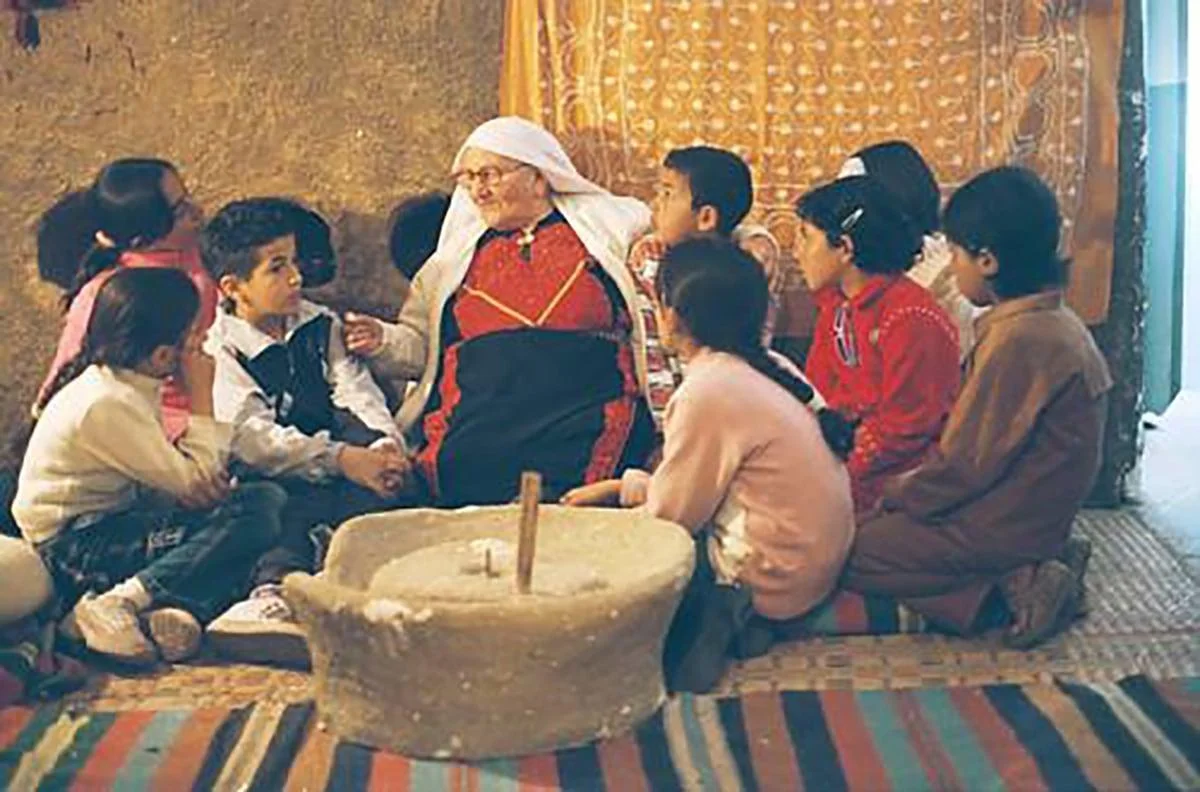
Traditionally, Hikaye gatherings took place in homes, often during winter evenings. Small groups of women and children would gather to listen, creating an intimate setting in which the storyteller could hold the room through language and performance.
Unlike a written story, an oral tale changes slightly with each telling. The storyteller may adjust a phrase, emphasise a character, pause for a reaction, or adapt the telling to the age and interests of the listeners. The story lives through the relationship between the person speaking and the people listening.
This is one reason oral traditions cannot be preserved by recording words alone. The voice, dialect, expression, timing, and social setting are part of the cultural practice.
In the Hikaye, the gathering itself matters. It creates a space for listening and shared imagination, where children encounter stories through the voices of older women and learn how stories are shaped and remembered.
3. The Language of the Hikaye: Palestinian Dialect and Voice
The Palestinian Hikaye is told in Palestinian Arabic dialects. UNESCO identifies both rural Fallahi and urban Madani forms.
This detail is important. The dialect is not simply a vehicle for delivering a story; it is part of the story’s identity. Pronunciation, vocabulary, expressions, and speech rhythms connect a tale to the people and communities who tell it.
A written transcription can preserve much of the narrative, but it cannot fully reproduce the storyteller’s voice. The same sentence may feel humorous, suspenseful, affectionate, or critical depending on its delivery.
The performance is therefore a kind of oral art. A skilled storyteller knows when to slow down, when to raise her voice, when to repeat a phrase, and how to keep listeners attentive until the story reaches its conclusion.
4. What Do the Stories Talk About?
The Hikaye’s fictional narratives often reflect real social concerns. UNESCO highlights family issues and the position of women in society, including stories about women caught between personal desire and social duty.
These themes give the tradition a distinctive perspective. The stories can examine the rules that govern family life, the expectations placed on women, and the tensions between individual wishes and collective obligations.
Fiction makes it possible to approach difficult subjects indirectly. A character’s experience can invite listeners to recognise a familiar problem, question an accepted rule, or consider a different point of view.
The stories should not be treated as straightforward historical records. Their value lies partly in how they express social attitudes, imagination, and lived concerns through narrative.
They offer a window into how communities have discussed relationships, responsibility, gender, and everyday life—not a literal account of every event or custom in Palestinian history.
5. Why the Hikaye Matters to Palestinian Cultural Heritage
The Palestinian Hikaye is part of a wider heritage of oral expression: stories, sayings, songs, memories, and forms of spoken knowledge that are carried through everyday life.
Its importance is especially connected to the role of women as cultural transmitters. The storyteller is not only an entertainer. She is a bearer of language, narrative forms, performance skills, and ways of interpreting social experience.
When a story is passed to a younger listener, more than its plot travels. Expressions, dialect, humour, ways of describing relationships, and the storyteller’s own interpretation can also be carried forward.
In 2008, UNESCO inscribed the Palestinian Hikaye on the Representative List of the Intangible Cultural Heritage of Humanity. The inscription recognised the tradition as a living cultural practice and documented its distinctive social and expressive features.
Recognition, however, does not mean that a tradition is automatically protected. It still depends on people who tell, listen to, record, teach, and value it.
6. The Challenges of Keeping an Oral Tradition Alive
UNESCO’s documentation identifies several pressures affecting the Hikaye, including the influence of mass media and disruption to social life in Palestine.
When people spend less time in the settings where stories were traditionally shared, opportunities for learning through listening and participation can become fewer. Older storytellers may also change the form or content of their narratives as social conditions change.
This is a challenge faced by many oral traditions. Their survival depends not only on preserving old recordings, but also on maintaining opportunities for people to tell stories and for younger generations to hear them.
Documentation can help. Recording a storyteller, preserving the original dialect, identifying the storyteller and the context, and making the material accessible to future generations can all contribute to safeguarding the tradition.
A United Nations report on cultural heritage in Palestine also describes efforts by the Palestinian Ministry of Culture to collect Hikaye stories from different governorates and preserve them as part of the country’s oral heritage.
Such work is important because a story without its storyteller, place, dialect, and context can lose some of the details that make it meaningful.
7. How Can the Palestinian Hikaye Be Preserved Today?
Safeguarding the Hikaye does not mean freezing it in the past. A living tradition can continue to develop while retaining a connection to the people and communities that carry it.
Several practical steps can help:
- Record storytellers with their permission: Preserve the original voice, dialect, and performance rather than relying only on written summaries.
- Document the context: Record the storyteller’s name, location, date, dialect, and the circumstances in which the story was told.
- Encourage intergenerational storytelling: Create opportunities for older women to share stories with children and younger listeners.
- Preserve regional variation: Avoid presenting one version or dialect as the only form of Palestinian storytelling.
- Support community-led archives: Work with Palestinian cultural organisations, researchers, families, and storytellers to keep recordings and transcripts accessible.
- Respect the storytellers: Obtain informed consent, agree on how recordings may be used, and credit the people whose knowledge is being shared.
Digital archives, educational projects, and community events can create new spaces for the Hikaye. But technology should support the storytellers and their communities, not replace their voices or take ownership of their narratives.
8. The Hikaye Is More Than a Story
The Palestinian Hikaye reminds us that cultural heritage is not held only in monuments, objects, or written documents. It can live in a voice, a phrase, a pause, and a room full of listeners.
For generations, Palestinian women have used stories to entertain, reflect on social life, and share ways of understanding the world. The stories may be fictional, but the human questions within them are recognisable: What does a family expect? What does a woman want? What happens when duty and desire come into conflict?
Preserving the Hikaye means keeping space for these voices to be heard—not only as echoes of the past, but as part of a living Palestinian cultural heritage.