Quick answer: The Palestinian keffiyeh (kufiya or hatta) is a traditional Arab headcloth that became a widely recognized symbol of Palestinian identity. Its political meaning grew during the 1936–1939 Arab Revolt and became strongly associated with Palestinian nationalism in the 1960s. The familiar woven patterns are often given symbolic interpretations today, but those meanings should not be presented as a proven, universal historical code.
1. What Is the Palestinian Keffiyeh?
The Palestinian keffiyeh—known as kufiya and, in some Palestinian contexts, hatta (الحطة)—is a square headcloth traditionally worn across parts of the Arab world. In Arabic, it is commonly called الكوفية الفلسطينية. When looking for an authentic keffiyeh or a keffiyeh made in Palestine, distinguish the scarf’s cultural style from verifiable information about where it was manufactured. It is commonly made from cotton and woven with distinctive geometric patterns. The black-and-white version is now especially associated with Palestinian identity, although keffiyehs have appeared in different colors and forms.
The keffiyeh is not exclusively Palestinian in origin. Its history is connected to wider regional clothing traditions, including its use among Bedouin communities. What makes the Palestinian keffiyeh distinctive today is the history and meaning that Palestinians have built around it: a practical garment became a visible expression of identity, collective memory, and political solidarity.
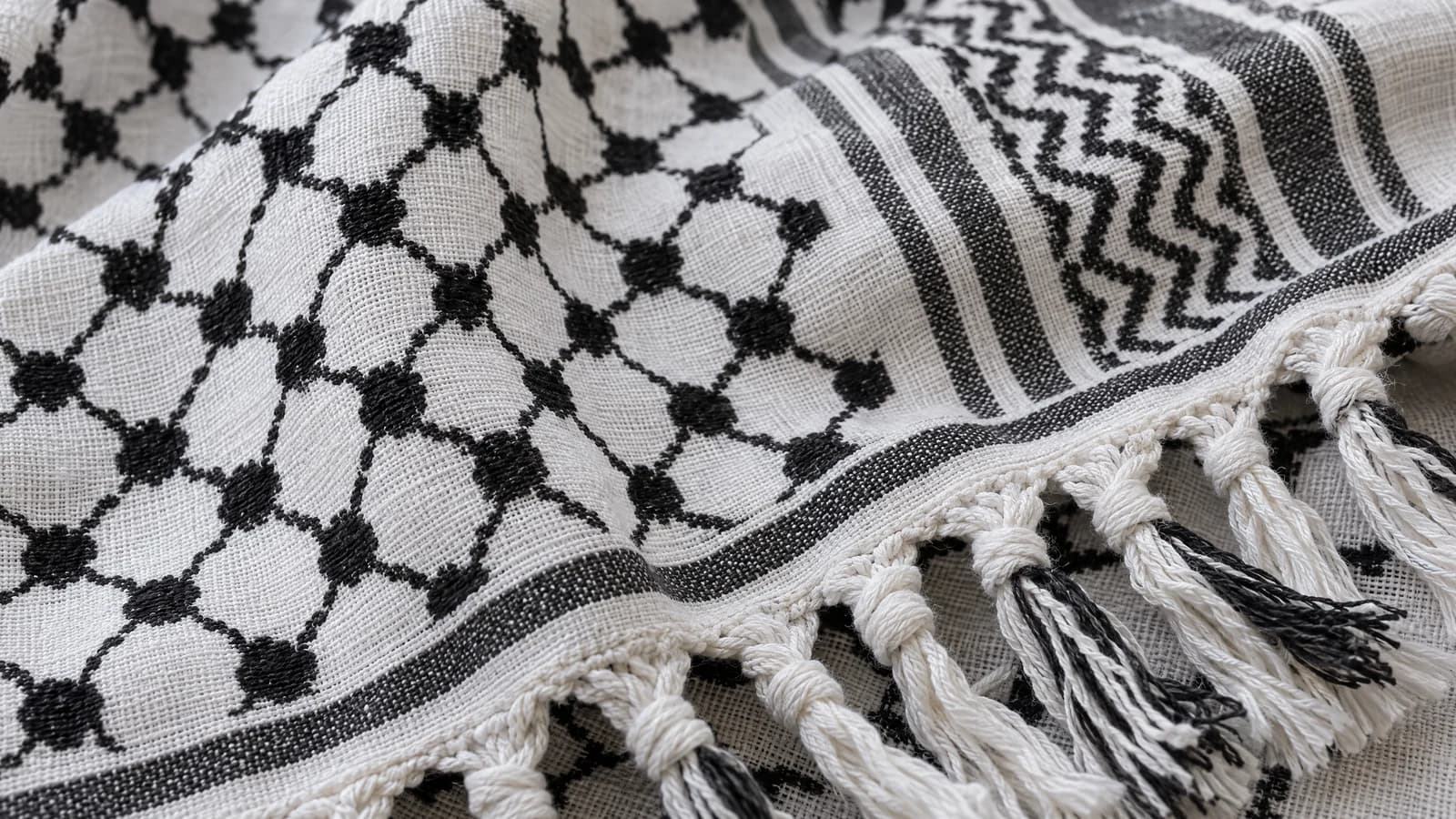
The weave and fringed edge are among the visible details of a traditional keffiyeh.
That distinction matters. A cultural object can be shared across a region while still acquiring a specific national meaning through the experiences of a particular people.
2. From Traditional Headwear to a Palestinian National Symbol
Before the 1930s: everyday dress
Dress historian Wafa Ghnaim, interviewed by NPR in 2023, described the keffiyeh as a garment historically worn by Bedouin men in Palestine. Before the 1920s, it was associated particularly with nomadic men and helped distinguish them from villagers, farmers, and townspeople. Historical examples also show that the keffiyeh was not always limited to the black-and-white palette most familiar today.
These details help place the scarf in everyday life before it became a widely recognized political symbol. Its later meaning did not come simply from the pattern woven into the fabric; it developed through how people wore it and what was happening around them.
The Arab Revolt of 1936–1939
During the Arab Revolt against British rule in Palestine, the keffiyeh took on a new political significance. According to Ghnaim's account in NPR, fighters in rural areas wore it partly to cover their features, and calls for men to wear the keffiyeh helped make it harder to distinguish rebels from other men. The garment became associated with collective resistance rather than only with a particular way of life.
The Palestinian Arab Revolt against British rule in Mandatory Palestine (1936–1939) included demands for independence and an end to Jewish immigration, as NPR explains. The keffiyeh's role in that period shows how clothing can become a shared public sign during a political struggle. It was not the moment the garment was created; it was a moment in which its use and meaning changed.
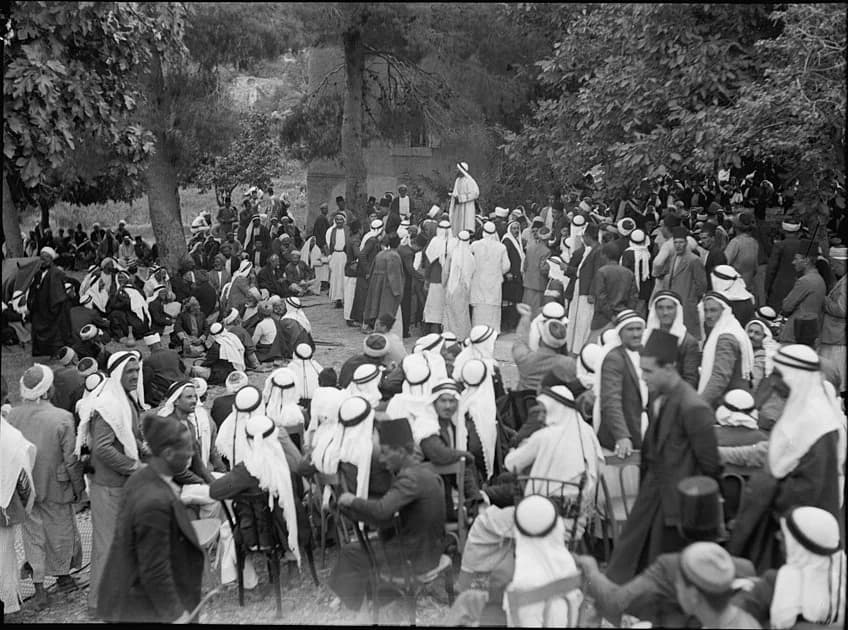
Archival image illustrating the period of the Palestinian Arab Revolt (1936–1939).
The 1960s and Palestinian identity
In the 1960s, the keffiyeh became more closely associated with Palestinian nationalism. Its public image was reinforced by political figures such as Yasser Arafat and by Palestinians who wore it as an expression of identity and solidarity. It also became more visible on women, not only as traditional headwear but as a scarf worn around the neck.
Today, Palestinians may wear the keffiyeh to express heritage, belonging, remembrance, or solidarity. For people in the diaspora, it can also be a tangible connection to family, place, and a culture that is often encountered through stories as well as direct experience. No single description captures what it means to every wearer; personal and political meanings can coexist.
3. What Do the Keffiyeh Patterns Mean?
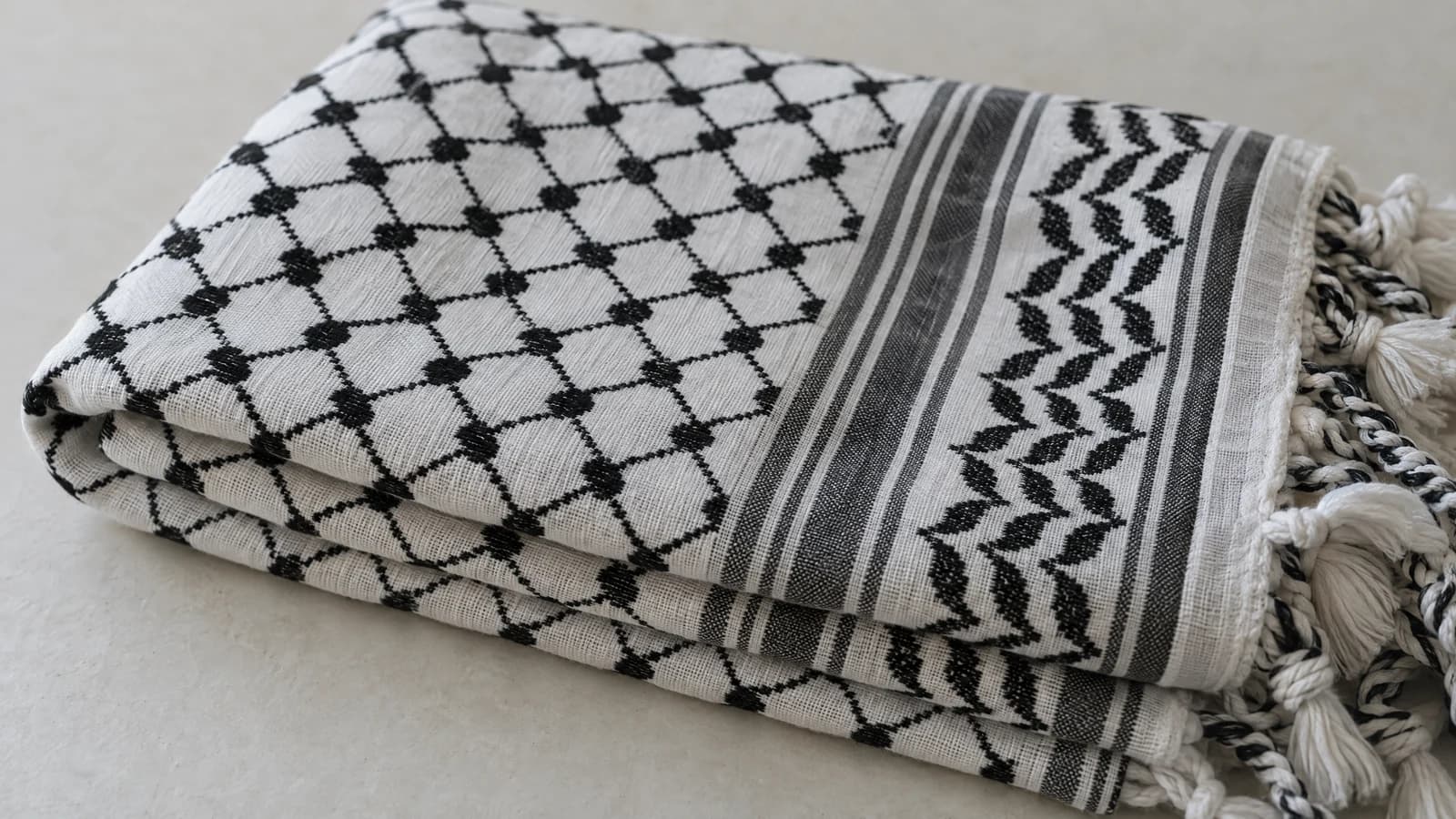
The familiar black-and-white keffiyeh has three commonly discussed design elements: a net-like pattern, wavy lines, and bold stripes along the edges. Popular explanations connect these patterns with Palestinian life and landscape.
- The net-like pattern is often said to evoke fishing nets and Palestinians' connection to the Mediterranean Sea.
- The wavy lines are often interpreted as references to olive trees or the movement of the land.
- The bold border stripes are sometimes said to represent historic trade routes.
These interpretations are widely repeated and can carry genuine meaning for people who wear the keffiyeh today. However, NPR's reporting, drawing on Ghnaim's research into historical dress, notes that historical evidence does not confirm these explanations as the original meanings of the patterns. The designs should not be treated as a fixed symbolic code in which each shape has one documented meaning.
A useful distinction is between historical evidence and contemporary cultural interpretation. A symbol can acquire meaning over time, even when there is no evidence that its maker originally designed it for that purpose. The keffiyeh's importance does not depend on proving that every stripe or shape was created to represent a particular part of Palestinian life.
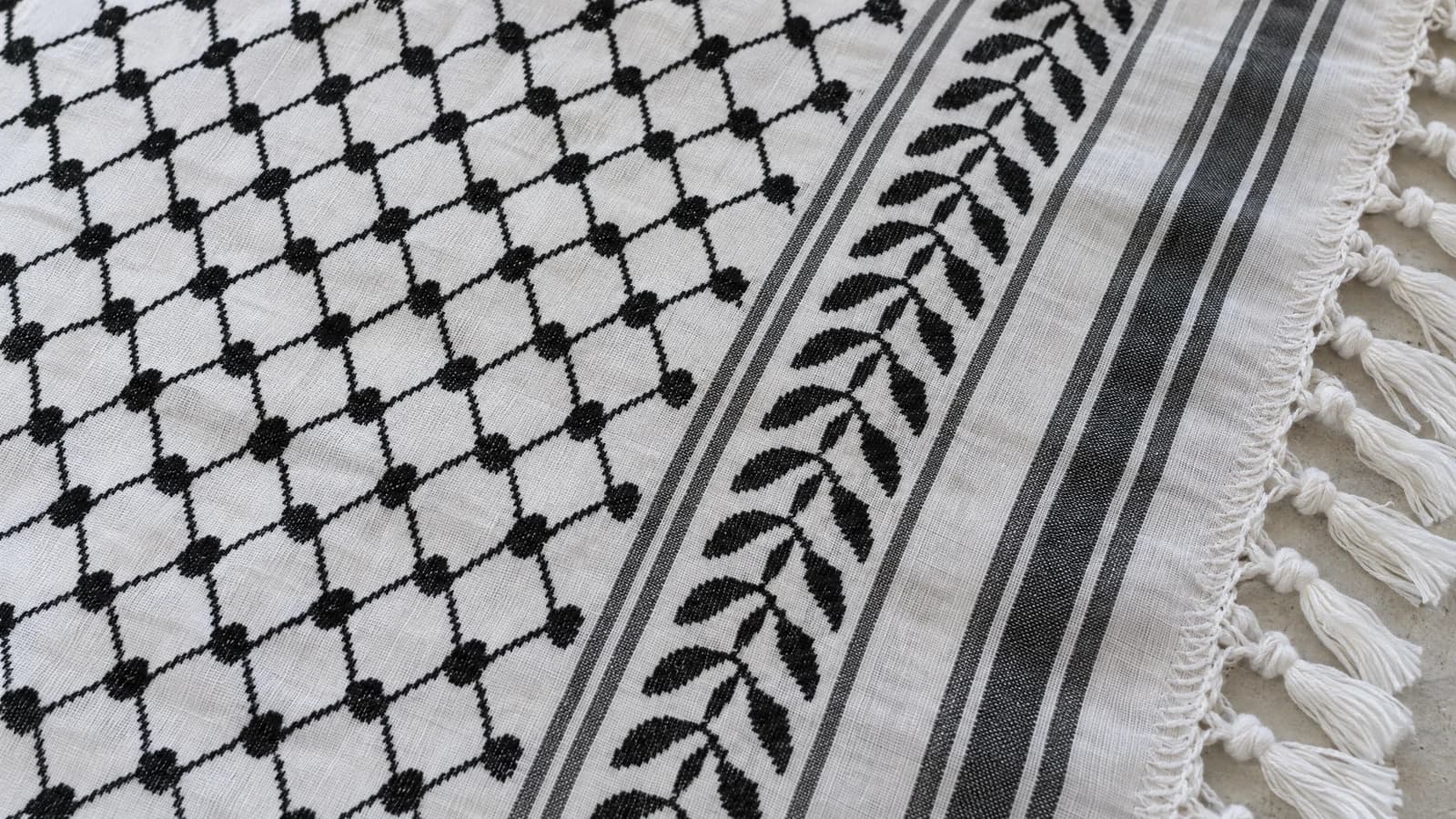
The keffiyeh’s woven designs are often interpreted symbolically today, though they are not a proven fixed historical code.
4. Why the Keffiyeh Matters Today
For many Palestinians, the keffiyeh is more than an accessory. It can express connection to a homeland, family memory, cultural continuity, and a demand to be seen as a people with a history and identity. It is worn at demonstrations, cultural gatherings, family events, and in everyday life.
Its meaning also travels with Palestinians who live outside Palestine. A scarf may be passed between relatives, given as a gift, or worn by someone learning about Palestinian culture. For non-Palestinians, wearing one may express solidarity, but it is worth understanding the history rather than treating the keffiyeh as a generic political pattern.
The garment can be meaningful without every wearer sharing the same reason for wearing it. A respectful account makes room for these differences and avoids reducing Palestinian identity to a single object.
5. The Hirbawi Factory in Hebron
The Hirbawi textile factory is an important part of the contemporary story of Palestinian-made keffiyehs. Hirbawi says its keffiyeh production began in Hebron in 1961, and its official website locates the factory in Habayel El-Riyah, Hebron, Palestine. The company describes itself as the last remaining factory producing keffiyehs in Palestine. That “last factory” statement is the manufacturer's own claim, repeated on its website; it should not be read as an independently verified industrial census.
Because the claim about being the last factory comes from the manufacturer itself, it is best attributed to Hirbawi rather than stated as an independently verified fact. Its website is also the appropriate place to check current production information and the channels it currently identifies for buying its products.
The factory matters to this story because it connects the keffiyeh to living textile production, not only to historical imagery. A scarf made in Palestine represents a different production history from a mass-produced item made elsewhere and decorated with a similar pattern. Both may look alike at first glance, but the place of manufacture and the people behind the work are not the same.
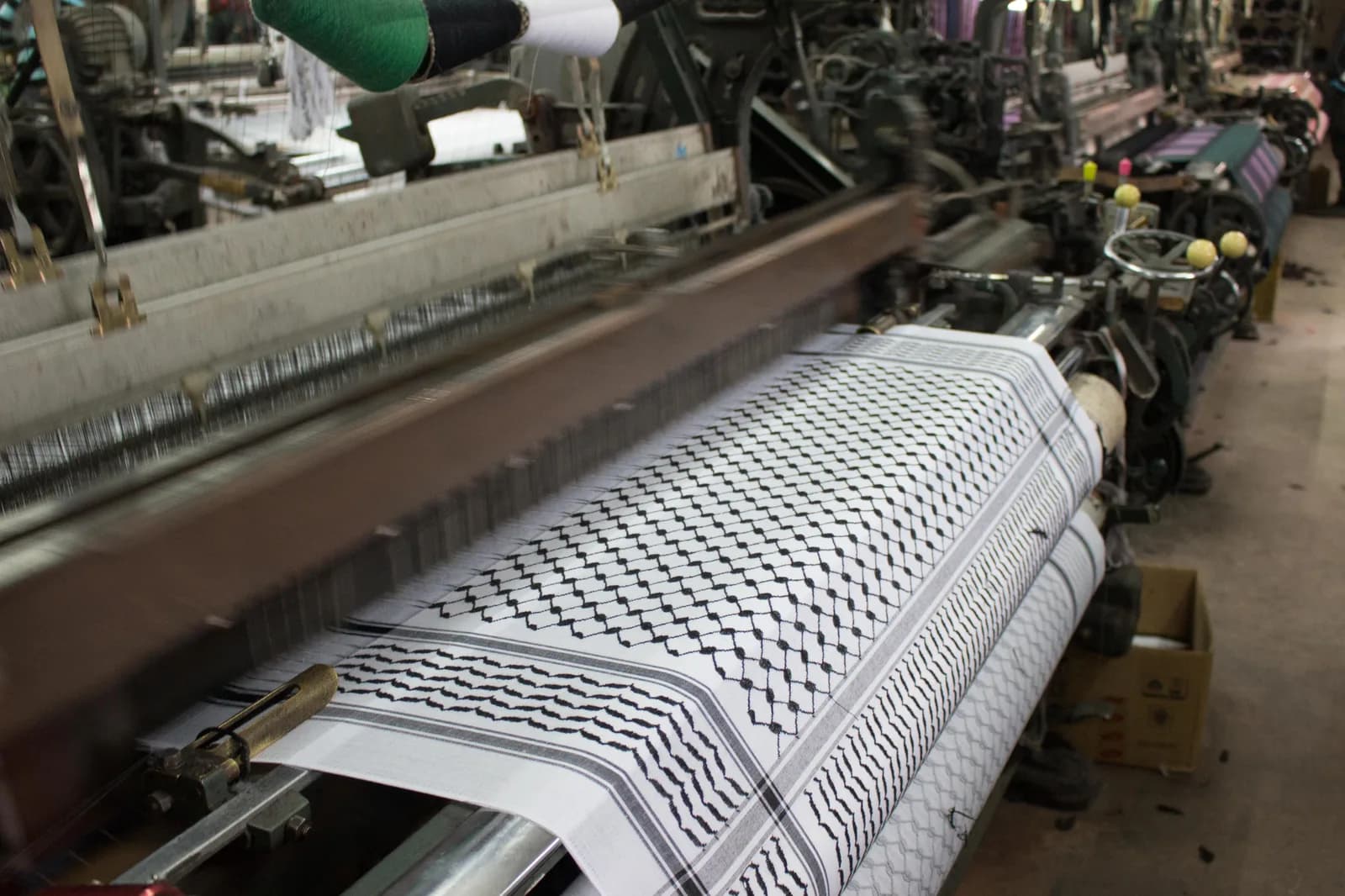
The Hirbawi textile factory in Hebron, where the company says keffiyeh production began in 1961.
6. How to Identify a Keffiyeh Made in Palestine
The pattern alone cannot prove where a keffiyeh was made. If origin matters to you, look for information that can be checked.
- Read the country-of-origin information. Look for a clear statement about where the scarf was manufactured, not just where it was designed, packaged, or shipped.
- Identify the maker. A seller should be able to name the factory, workshop, cooperative, or artisan responsible for the product.
- Check the maker's own guidance. Hirbawi currently says it sells worldwide through its official shop, kufiya.org, and identifies hirbawiusa.com as a partner in the United States. Check its current guidance before buying, because sales channels and availability can change.
- Ask questions when the description is vague. “Palestinian style,” “keffiyeh pattern,” or “inspired by Palestine” does not necessarily mean the scarf was made in Palestine.
- Be cautious with unsupported authenticity claims. A label, a familiar pattern, or a product photograph is not sufficient evidence of origin.
Check the maker's own current guidance before purchasing. Hirbawi says it sells worldwide through its official shop, kufiya.org, and names hirbawiusa.com as a partner in the United States. This guidance concerns Hirbawi products; it is not a broad or permanent directory of all Palestinian textile makers. Other makers may exist, and their provenance should be assessed on its own evidence.
Choosing a product with clear provenance helps the buyer understand what they are supporting. It also avoids treating Palestinian cultural imagery and Palestinian-made production as interchangeable.
7. Keffiyeh, Shemagh, and Ghutra: What Is the Difference?
These words are used across different Arabic-speaking communities, and their meanings can overlap. There is no single naming rule that applies uniformly in every country or household.
- Keffiyeh / kufiya: A common name for a patterned square headcloth; the black-and-white version is particularly associated with Palestinian identity.
- Shemagh: Often used for patterned headcloths, including red-and-white styles familiar in parts of the Arabian Peninsula and Jordan. Its use varies by region.
- Ghutra: In some Gulf contexts, this commonly refers to a headcloth that is often plain white, though colors and naming practices vary.
These are practical distinctions, not universal definitions. Regional terminology, color, folding style, and local custom all influence what people call a headcloth. If you are describing a specific item, the maker's own name for it and the context in which it is worn are more reliable than assuming the words always refer to separate, fixed categories.
8. How to Wear a Keffiyeh
There is no single correct way to wear a keffiyeh. Some people fold it into a triangle and drape it over the head, securing it with a cord in styles common across parts of the region. Others wear it loosely around the neck or shoulders. Palestinian demonstrators and diaspora communities also commonly wear the scarf around the neck as a visible expression of identity or solidarity.
If you are wearing a keffiyeh as cultural dress, take the time to learn about the garment and its context. If it is a gift, consider including a short note explaining where it was made and what the giver hopes to acknowledge. The aim is not to follow a rigid checklist, but to wear it with awareness of its history and of the people for whom it carries personal meaning.
Key Terms
- Keffiyeh / kufiya: A traditional square headcloth worn in parts of the Arab world; strongly associated with Palestinian identity today.
- Hatta: A term used for the headcloth in some Palestinian and regional contexts.
- Arab Revolt (1936–1939): The Palestinian uprising against British rule during which the keffiyeh gained a more explicit political association.
- Hirbawi: A textile factory in Hebron that says its keffiyeh production began in 1961.
- Provenance: Information about where an item was made, by whom, and how its origin can be verified.
Frequently Asked Questions
What does the Palestinian keffiyeh symbolize?
For many Palestinians, it represents identity, heritage, solidarity, and the national struggle. Its meaning developed over time, especially through its use during the 1936 revolt and its association with Palestinian nationalism in the 1960s.
Do the keffiyeh patterns have proven historical meanings?
Popular interpretations connect the net-like design with the sea, the wavy lines with olive trees, and the border stripes with trade routes. These interpretations are widely repeated, but available historical evidence does not establish them as an original, universal code.
Is the keffiyeh exclusively Palestinian?
No. The keffiyeh is a traditional Arab headcloth with a broader regional history. Its black-and-white form, however, has become particularly associated with Palestinian identity through the garment's modern political and cultural history.
Where is the Hirbawi keffiyeh made?
Hirbawi says its keffiyeh production began in Hebron in 1961, and its official website gives the factory location as Habayel El-Riyah, Hebron, Palestine. The company's claim that it is the last keffiyeh factory in Palestine is a self-description, not an independently verified industrial census.
How can I tell whether a keffiyeh is made in Palestine?
Check the stated country of manufacture, identify the maker, and look for verifiable provenance. If a product is sold as a Hirbawi keffiyeh, check the factory's current guidance: it names kufiya.org as its worldwide shop and hirbawiusa.com as a U.S. partner. A Palestinian pattern alone does not prove where an item was made.
Is a keffiyeh the same as a shemagh or ghutra?
The terms overlap and vary by region. Keffiyeh or kufiya is widely used for the patterned scarf associated with Palestine; shemagh often describes patterned headwear, while ghutra often refers to a plain headcloth in some Gulf contexts. These distinctions are not universal.
A Cloth with a Living History
The Palestinian keffiyeh carries several histories at once: a practical headcloth with regional roots, a garment whose public meaning shifted during the 1936 revolt, and a recognizable symbol of Palestinian identity in the decades that followed. Its patterns invite interpretation, but their cultural importance should not be confused with proof of a fixed design code.
For anyone choosing a keffiyeh as a gift or buying one to wear, the most useful questions are simple: What does it mean to the people who wear it? Who made this particular scarf? And can its origin be explained honestly? Those questions respect both the history of the garment and the people who continue to give it meaning.
Continue exploring Palestinian heritage with our guides to reading a Palestinian thobe, Palestinian embroidery (tatreez), and meaningful Palestinian gifts.
Sources and Further Reading
- Linah Mohammad, Courtney Dorning, and Ailsa Chang, NPR, “How the keffiyeh became a symbol for Palestinian liberation” (December 4, 2023), audio report and transcript via North Country Public Radio. Discusses the shift from everyday headwear to political symbol and the 1936 revolt's demands for independence and an end to Jewish immigration.
- Linah Mohammad, NPR, “What is a keffiyeh, who wears it, and how did it become a symbol for Palestinians?” (December 6, 2023). Includes commentary from Palestinian dress historian Wafa Ghnaim on the garment's history, its changing political meaning, and the limits of historical evidence for popular pattern interpretations.
- Hirbawi, Official website. The manufacturer's own information about its factory and production.
- Hirbawi, Where to Buy Authentic Hirbawi Kufiyas. The manufacturer currently identifies kufiya.org as its worldwide shop and hirbawiusa.com as a U.S. partner; these are the channels it lists at the time of writing.
- Palestinian Museum, The Road to the 1936 Revolt. Historical context for the revolt in which the keffiyeh gained political significance.