1. Reading a Palestinian thobe is about context, not a single code
A Palestinian thobe can offer clues about place, materials, occasion, family history, and changing fashion. But embroidery is not a universal code. A single color, motif, or stitch cannot reliably identify a village, a woman’s marital status, or the age of a garment on its own.
The safest reading begins with the whole object: its cut, fabric, panels, construction, thread, documented provenance, and historical context. That is the difference between a careful interpretation and a decorative guess.
This guide explains what to look at first, what terms such as qabbah, banayeq, and shinyar may refer to, and why regional patterns became less fixed after 1948. It also distinguishes between what a museum record documents and what a viewer may only infer.
2. What is a Palestinian thobe?
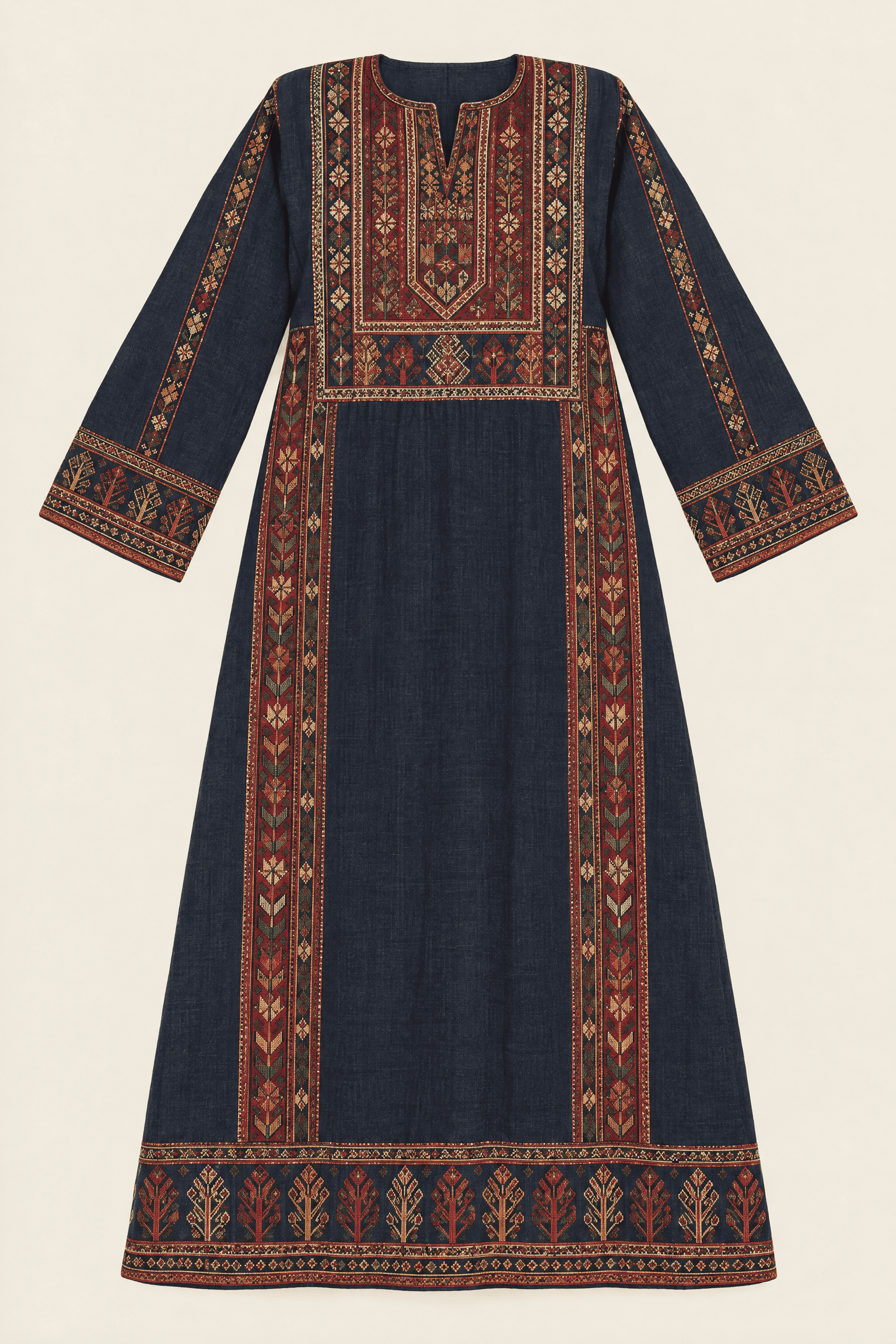
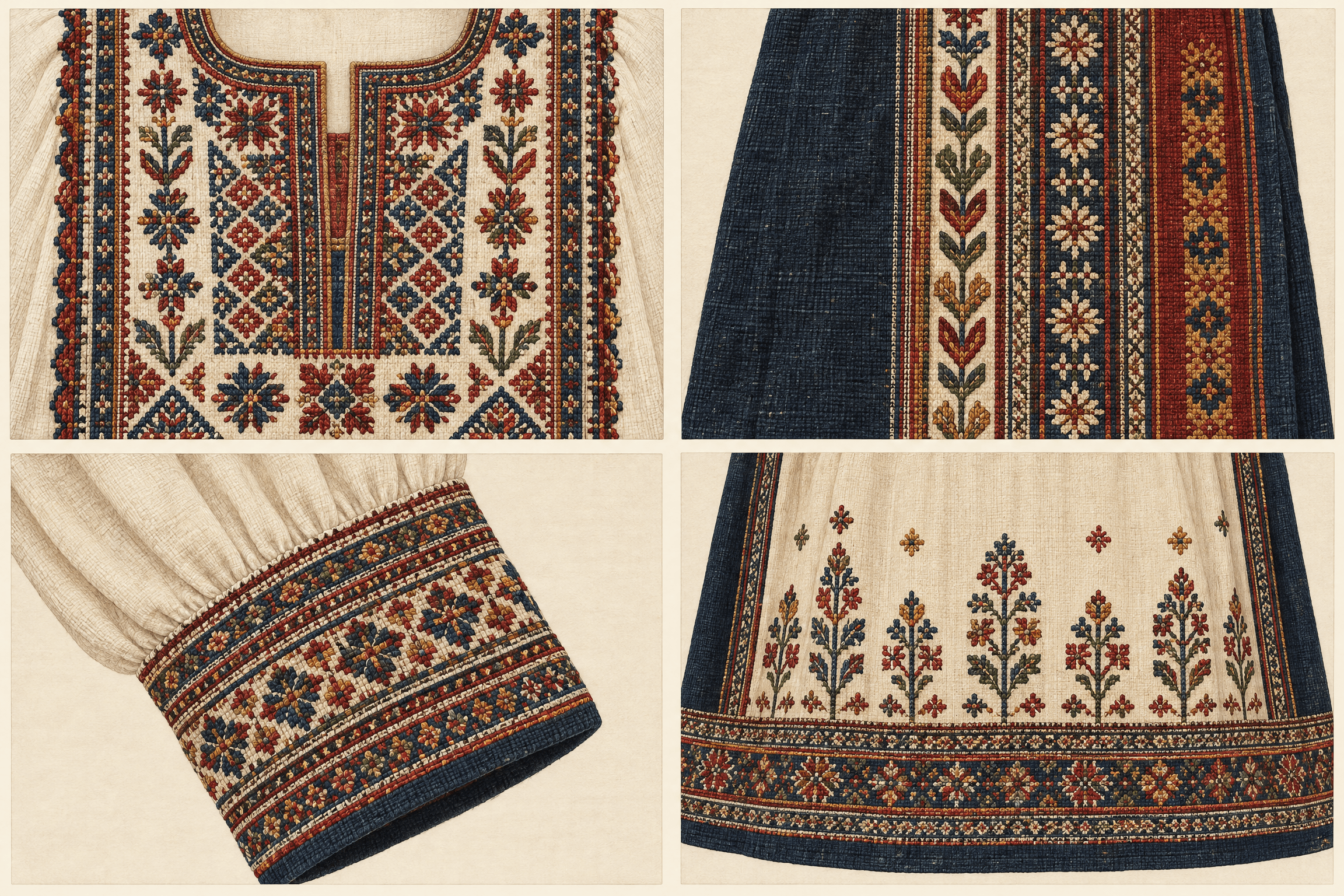
A thobe is the long, loose-fitting dress that forms the main garment in many descriptions of Palestinian women’s traditional clothing. UNESCO’s description of Palestinian embroidery places embroidery on the chest, sleeves, sleeve cuffs, and vertical panels extending from the waist toward the hem.
The word does not describe one identical dress worn everywhere or in every period. Museum records show garments made from different fabrics, colors, embroidery arrangements, and construction details. A thobe from Bethlehem should not automatically be treated as interchangeable with one from Ramallah, the southern coastal plain, the Hebron Hills, the Galilee, or the Negev.
It is also important to distinguish a historical garment from a contemporary piece inspired by Palestinian dress. Modern makers may preserve older techniques, combine regional references, adapt the cut, or create new designs. That does not make the newer work less meaningful, but it does change what can responsibly be inferred from it.
3. What should you look at first: the motif or the garment’s structure?
Start with the structure. Before asking what an embroidered flower, bird, tree, or geometric shape “means,” record what the garment is made of and where the decoration is placed.
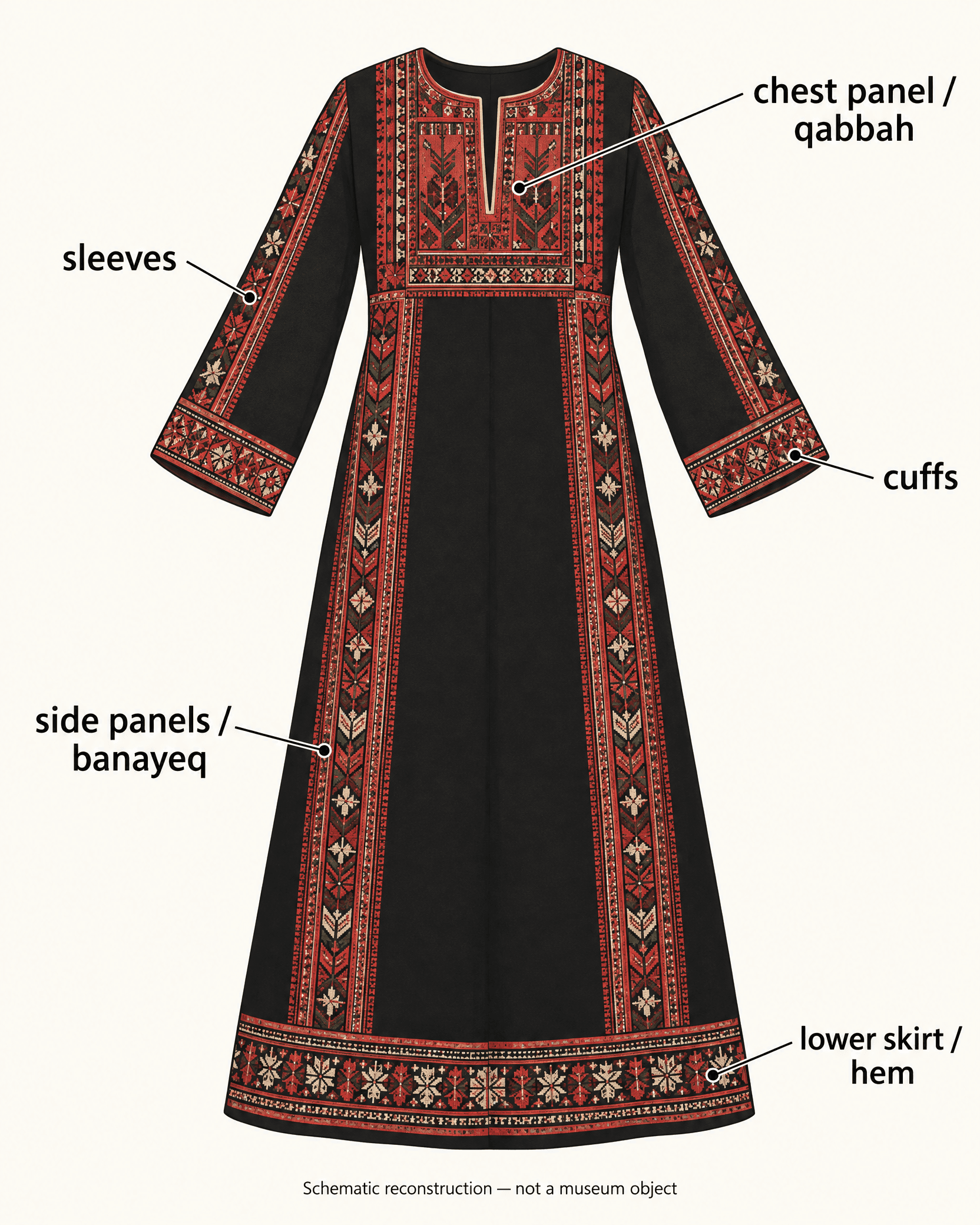
A useful first description includes:
- the garment type: thobe, coat, jacket, shirt, sash, or another piece;
- the main fabric and its color;
- the chest panel and neckline;
- the side panels or banayeq, if the source uses that term;
- the sleeves and cuffs;
- the back panel, lower skirt, and hem;
- applied fabric, woven stripes, metallic thread, or other materials;
- the documented region, date range, use, and collection history.
This order matters because the same motif can look different when it appears on a chest panel, a sleeve, a side panel, or the lower back of a dress. A museum record may identify a part by a particular Arabic term, while another source may use a different transliteration or a broader English description. The record for a specific object should take priority over an assumed universal glossary.
4. What is the qabbah or chest panel?
The term qabbah—also written qabeh in some museum records—is used for the chest panel of a thobe. Embroidering Identities describes the qabbah as one of the most important and heavily embroidered parts of the dress. The book also discusses how color and design in this area could be associated with a village or region in particular contexts.
British Museum records use qabeh for the chest panel of specific garments. One catalogued thobe is described as embroidered on the qabeh, side panels, sleeves, and the back of the skirt.
That evidence supports a careful conclusion: the chest panel can be an important place to look for regional and historical clues. It does not support the stronger claim that every qabbah follows one regional template or that one chest-panel design identifies a village with certainty.
5. What are the side panels, vertical panels, and back panels?
Sources use several terms for the areas beside or below the chest. The Palestinian Museum’s object records refer to banayeq in descriptions of particular dresses. UNESCO describes vertical embroidered panels running from the waist toward the bottom of the thobe. Embroidering Identities uses terms including shinyar for a lower back panel and mawaris for vertical embroidered bands.
These terms should not be flattened into one interchangeable English label. They may describe related areas, but their exact use can depend on the garment, the region, the source, and the transliteration. When writing about a specific thobe, use the term supplied by the object record and explain its location in plain English.
This is also where construction and decoration overlap. A panel can be part of the garment’s structure and a major display area for embroidery. In one Palestinian Museum record, for example, the back area, side panels, sleeves, and hem are described separately because their embroidery arrangements differ.
6. Can embroidery tell you which region a thobe comes from?
Sometimes it can provide a regional clue, especially when several features point in the same direction. The strongest reading combines the embroidery with the fabric, cut, color arrangement, panel layout, documented provenance, and date range.
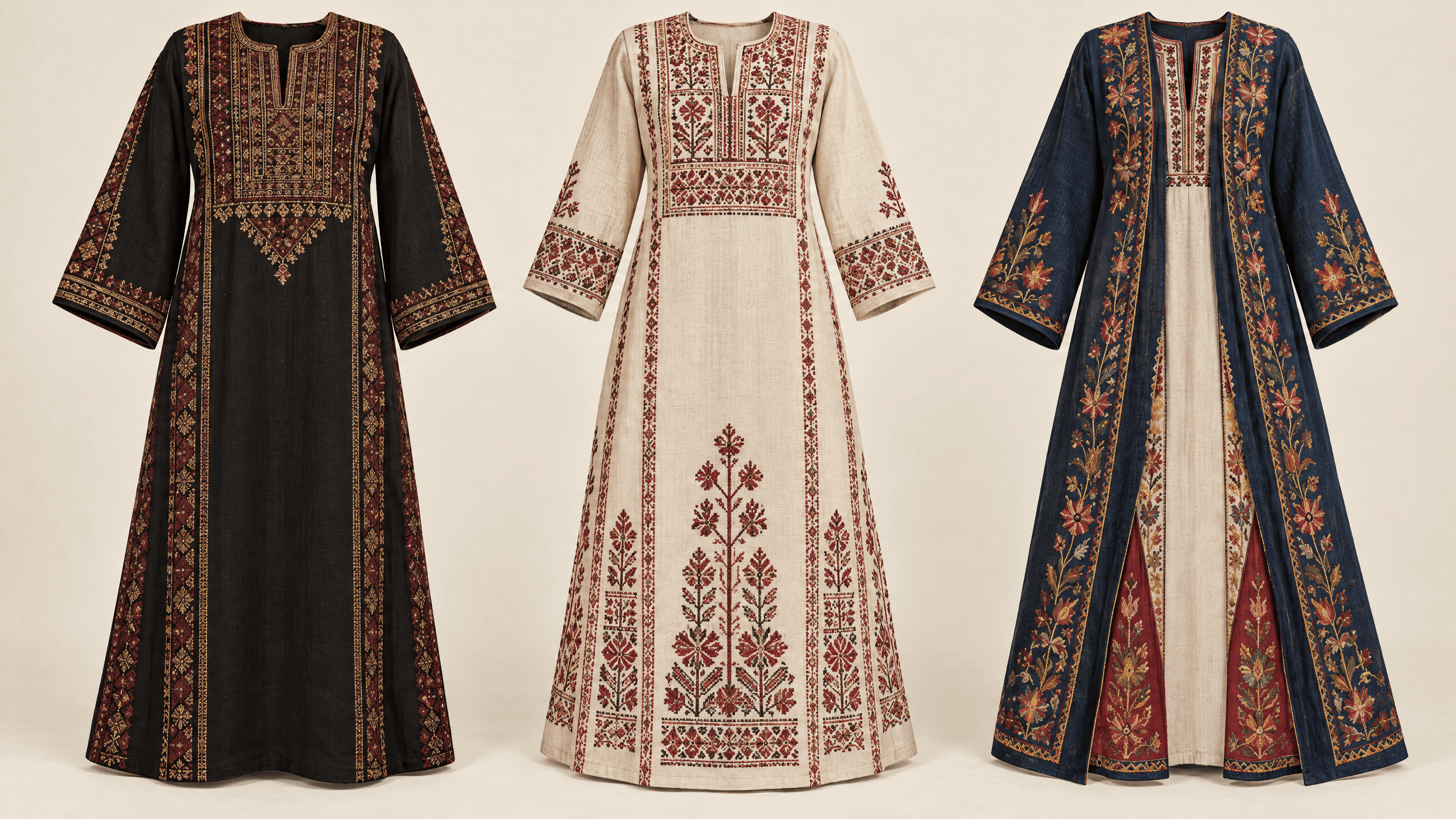
Museum records provide useful examples. The Palestinian Museum catalogs garments associated with Bethlehem, Ramallah, Bir Sabe‘, Sarafand, Jerusalem and Bethlehem, and Bayt Nabala. These records describe different fabrics, colors, stitches, panel arrangements, and uses. British Museum records likewise document specific dresses associated with the southern plain, the south-western coastal plain, and the Hebron Hills. A V&A record describes a jellayeh coat associated with Acre and the Galilee, worn over inner garments or over a shirt and shirwal trousers in the catalog description.
These examples demonstrate regional variation in documented objects. They do not create a complete map of every Palestinian village or period. One catalog record can tell us what is documented about one garment; it cannot, by itself, establish a rule for every garment made in the same region.
7. What can color and motifs tell you about social status or occasion?
Color and motifs may carry social information in a particular historical or community context. UNESCO states that the selection of colors and designs can indicate regional identity and social status, including marital and economic status. Embroidering Identities similarly discusses clothing as a way of expressing regional identity, age, status, wealth, and life circumstances.
The wording matters. “Can indicate” is not the same as “always means.” A red motif is not a universal statement about marriage. A cypress tree, bird, flower, or geometric pattern should not be assigned one fixed meaning without a source that connects that design to a specific community, period, or maker.
Occasion matters too. Some records describe garments as wedding dresses, everyday dresses, or ceremonial clothing. In other cases, the catalog fields may be incomplete or even inconsistent. The Palestinian Museum record for one Abu Qutba dress, for example, describes it as a wedding dress while the use field records “everyday dress.” That discrepancy should be reported rather than silently resolved.
A responsible article should therefore use phrases such as “the source associates,” “the record describes,” or “this may suggest,” rather than presenting an interpretation as a fact about every wearer.
8. How did the thobe change after 1948?
The thobe and the practice of embroidery changed through displacement, changing access to materials, new forms of organizing craft, and new modes of dress and memory. After 1948, many Palestinian families lived in refugee camps, in cities, in villages, or in diaspora communities. They continued to sew, teach, and adapt embroidery in new settings, even when the historical garment form and the original production chains were no longer fully intact.
This matters because it changes what we can infer from a garment. A modern thobe may preserve family references, village memory, or inherited stitch patterns while also reflecting new materials, more mobile communities, and cross-regional design influences. That is not a loss of authenticity. It is the living continuation of a practice that has always adapted to time, place, and migration.
9. A responsible way to read a thobe
The best reading is layered and humble. It begins by identifying the garment type, fabric, colors, cut, and panel arrangement. It then places the embroidery in the context of the source record, the date range, and related garment traditions. Only after that can a reader discuss a motif, a chest panel, or a palette as a clue rather than as a fixed fact.
If you want to read a thobe responsibly, ask:
- What exact garment is this?
- What fabric and thread are used?
- Where is the embroidery placed?
- What does the object record actually say?
- What is documented, and what is inferred?
- Does this object belong to a specific village or a wider regional tradition?
That approach is slower than a quick “this pattern means X,” but it is much more honest—and much more useful.
10. Sources and further reading
- UNESCO, “The art of embroidery in Palestine, practices, skills, knowledge and rituals” (2021)
- Shelagh Weir, Palestinian Costume (1989)
- Tania Tamari Nasir and Iman Saca, Embroidering Identities (2006)
- Palestinian Museum object records and catalog descriptions
- British Museum object records and catalog descriptions
- V&A collections records for regional garments and coats
These resources emphasize that embroidery is a historical practice shaped by region, material, garment structure, and community memory—rather than a single fixed visual code.
What to Read Next
- Learn the basic stitches and craft language: What Is Tatreez?
- Explore regional variation: Regional Motifs in Palestinian Embroidery
- Understand the broader heritage context: Palestinian Tatreez: The Embroidery Heritage of Gaza