1. Introduction: More Than Embroidery
Palestinian tatreez (تطريز, tatreez) is not simply decoration. It is a textile practice rooted in women’s labour, family knowledge, garment-making, regional variation, and cultural continuity. In Palestine, embroidery has long been stitched onto dresses, jackets, sleeves, headcloths, and borders, creating a visual language that is at once personal and communal. UNESCO recognised this heritage in 2021 when it inscribed the “art of embroidery in Palestine, practices, skills, knowledge and rituals” on the Representative List of the Intangible Cultural Heritage of Humanity. The inscription emphasised that embroidery is transmitted through practice, ritual, and everyday life rather than only through museums or heritage institutions.
That wider Palestinian context matters. If we focus on Gaza, we should do so carefully. Gaza is a significant site in the southern Palestinian coastal landscape, yet it is not the same thing as all Palestinian embroidery, and it should not be treated as a single undifferentiated “national” pattern. The craft is geographically varied, and the evidence for specific Gazan practices is often more limited than for the southern coastal region as a whole. In English-language writing, this distinction matters: we can talk meaningfully about Palestinian embroidery and its connection to Gaza without overstating what can be confidently documented.
For readers seeking a grounded understanding, the best approach is to treat tatreez as a regional craft culture with documented commonalities and important differences between districts, villages, and families. Gaza belongs in that story, but only with the right historical precision.
2. What Is Palestinian Tatreez?
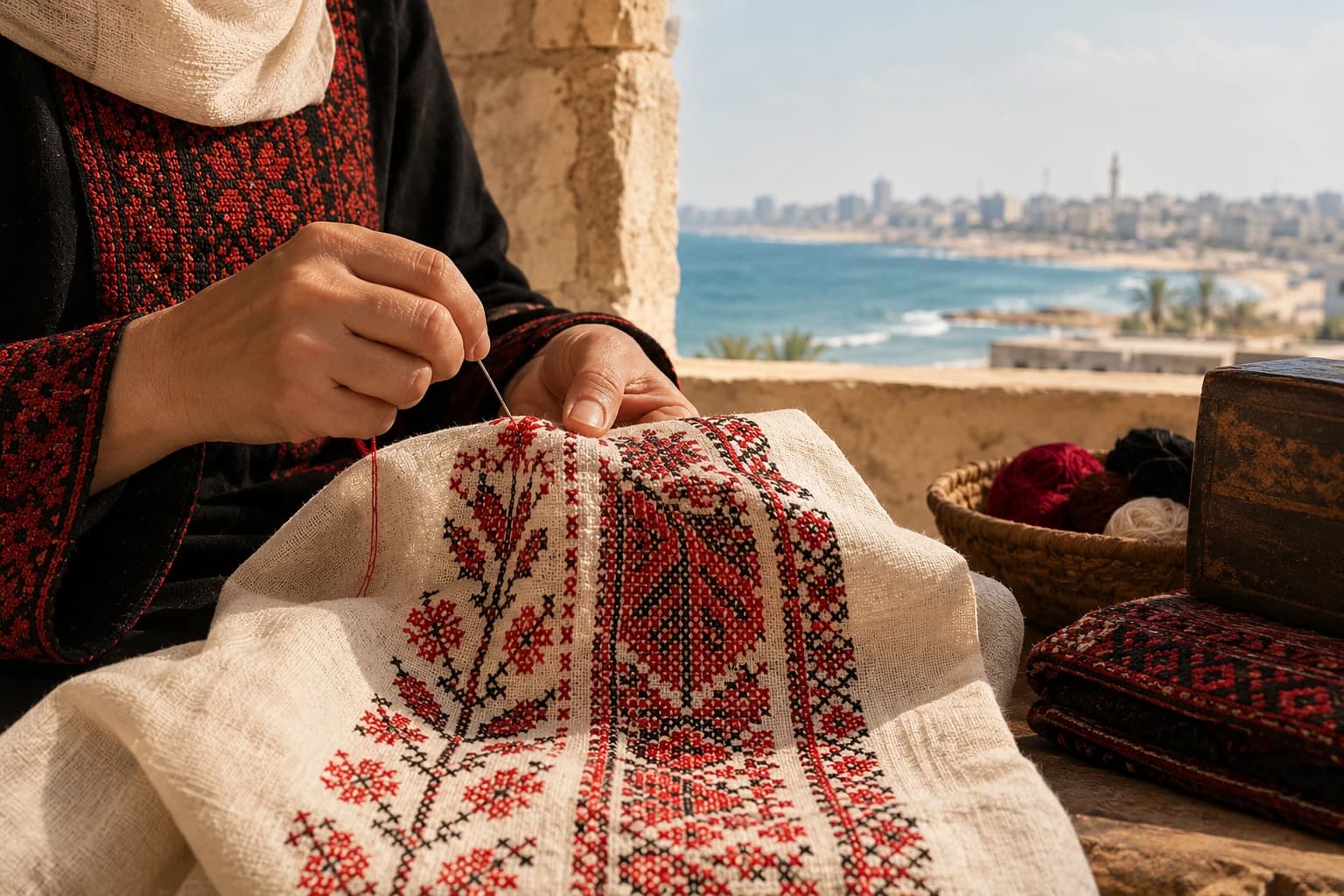
Tatreez is the traditional counted cross-stitch embroidery of Palestine. It is done on woven cloth, most often linen or cotton, using strong thread and a careful sequence of stitches to build geometric and commemorative patterns. The result is not merely decorative texturing: it shapes the garment itself. In historical dress, embroidery often framed a woman’s chest panel, sleeves, and borders, creating a composition that could reflect local style, garment function, marital status, and village or district identity.
The craft developed within a wider textile culture that valued dense, durable stitching and practical clothing as much as pattern. Traditional garments were not static costumes; they were wearable, social, and often highly localised forms of dress. As UNESCO’s description emphasises, women’s village clothing typically included a long dress, trousers, a jacket, a headdress, and a veil, each often embroidered with motifs including birds, trees, and flowers. The precise forms of these garments varied by region and period, and no single design can stand in for all Palestinian dress.
In practice, tatreez relies on a countable weave. The stitch structure was historically developed to work with locally available fabrics and regional dye traditions. Thread could be cotton, silk, or dyed wool depending on the garment and local material culture. Dense stitching, strong tension, and careful repetition are hallmarks of the craft. Even a simple border could carry a great deal of technical knowledge: which colours were used, how a motif was repeated, how it was framed, and which part of the garment it occupied.
The famous chest panel, or qabbeh (qabbeh), is one of the clearest examples of how garments were designed as visual systems. In many traditions, the front of the dress was organised around a rectangular or medallion-like centre field, often with borders that narrowed or broadened to fit the garment. Side panels, or banayiq (banayiq), could also carry vertical or diagonal motifs, creating rhythm along the garment’s length. These layouts are not merely decorative; they are part of the logic of carving meaning and local identity into cloth.
The craft is also a social practice. Embroidery was a learned skill, transmitted through mothers, female relatives, neighbours, and community networks. This matters because the practice cannot be reduced to “tradition” as an abstract concept. It was a lived craft with labour, practice, training, and aesthetic judgement.
3. Gaza and the History of Palestinian Embroidery
When historians write about Palestinian embroidery, they often emphasise the breadth of the tradition across the country rather than a single “Gazan” style. This is important context for any article on Gaza. The historical record shows a rich embroidery culture across Palestinian districts, but the firmest evidence frequently sits at the level of broader regional traditions rather than a precise, easily traceable “Gaza embroidery school.”
That is not to say Gaza is absent from the story. The southern Palestinian coast, including Gaza and nearby districts, is part of the wider material and textile landscape of Palestine. Textile historians and museum records point to a southern coastal and inland network in which embroidery styles, fabrics, and garments circulated, were adapted, and were learned between communities. At the same time, evidence for a distinct, exclusively Gazan embroidery repertoire is more limited than the broader public often assumes.
This is where careful scholarship matters. The embroidery heritage associated with Gaza should be described as connected to a southern coastal textile culture, while acknowledging that historical evidence often identifies a broader Palestinian or regional pattern rather than an exact Gazan lineage for every motif or garment type. There can be a documented Gaza connection without claiming that all Palestinian embroidery originated in Gaza, or that every motif in the Palestinian repertoire belonged specifically to the Gaza region.
The UNESCO inscription is significant here because it names the heritage at a national and regional level: the art of embroidery in Palestine, with its practices, skills, knowledge and rituals, as a living tradition across rural Palestine and the diaspora. It does not reduce the practice to a single site. In other words, the UNESCO framework supports a strong understanding of Palestinian embroidery as a distributed cultural heritage while still allowing local and regional specificity within it.
The southern coastal region also contains a key historical distinction: Gaza and historic Majdal are not interchangeable labels. This distinction matters if we want to understand the material record accurately. Gaza City is a specific urban and regional centre. Historic Majdal, known historically in relation to the southern coastal plain and later associated with the area now known as Ashkelon, is a different geographical and historical reference point. Treating them as the same thing blurs the regional map and undermines the precision a heritage article should aim for.
4. Gaza, Majdal, and Regional Textile Traditions
The relationship between Gaza and Majdal is one of the most commonly misunderstood parts of the Palestinian embroidery story. The key issue is not whether there were connections between the southern coastal region and Gaza—clearly there were. Rather, it is whether one can confidently collapse all of those traditions into a single simplified identity. In careful scholarship, the better approach is to treat them as related but distinct sites within a wider southern coastal textile sphere.
This regional distinction becomes especially useful when looking at garments, fabrics, and colours. Histories of Palestinian embroidery often describe a range of local cloth traditions: linen, cotton, dyed cloth, and embroidered panels on dresses or shawls. In the southern coast, historical materials and colour palettes could differ from those found in Ramallah, Hebron, or the Galilee, reflecting local textile practices, imported goods, and trade links. A Gaza-associated garment may use a different balance of fibre, weight, and stitch density than a garment associated with central or northern Palestinian communities.
The southern coastal region also has a strong relationship with weaving and textile production, including areas linked to what has been described in scholarship and museum literature as the Majdalawi tradition. While this broad connection should be treated as a regional textile history rather than as proof that all embroidery styles were identical, it does help explain why some southern garments or coastal textile forms are more visually distinctive than others. The textile culture of the region was shaped by coastal movement, market exchange, and local craft adaptation.
This is why the safest way to write about Gaza is to describe the evidence as “documented embroidery associated with Gaza and the southern coastal region,” rather than “all Palestinian tatreez is Gazan.” Such a phrase is both more accurate and more useful to readers. It allows for a historical narrative that includes Gaza without sacrificing the wider geographical and cultural complexity of Palestinian textile heritage.
5. Reading the Patterns: Motifs, Materials, and Techniques
Tatreez patterns are often discussed as if they were a single symbolic code. In literature and online writing, motifs are sometimes given grand universal meanings—protection, fertility, resistance, or a fixed ethnic mark. That is a risky way to write about heritage. The stronger and more evidence-based approach is to describe motifs as regional forms shaped by local practice, repeated in garments and borders, without insisting on one universal explanation for every design.
Motifs commonly noted in Palestinian embroidery include geometric bands, stars, triangles, cypress-like forms, and floral or plant-inspired repeated shapes. These patterns are often built from a disciplined system of counted stitches. A visual motif may be repeated in a border, placed around a central medallion, or arranged in a vertical panel to frame the dress. In many historical garments, the pattern did not simply “decorate” the cloth; it structured the garment, marking its use and its origin.
The exact terminology varies across communities and historical sources. Some motifs are named for local forms or family practices; others are more general descriptors used by collectors, historians, or contemporary craft educators. This variation matters. It is precisely why a careful article should avoid assigning a single symbolic meaning to a motif unless a reliable source documents that meaning. The safest writing is descriptive: “geometric border,” “triangular protective form,” “cypress-like motif,” “floral repeat,” rather than “this symbol meant X.”
Materiality also matters. In historical Palestinian dress, the base fabric, thread quality, and stitches were not neutral. The same pattern could look very different on linen, handwoven cotton, or a denser woven base. Thread colour and ground colour created the legibility of the motif. Dark indigo or midnight blue cloth, natural linen, and bright red, magenta, olive, or green threads all produced different visual effects. This variation is part of how artisans and wearers distinguished garment styles across regions.
This is particularly relevant for writing about Gaza and the southern coast. The textile culture there is often associated with strong contrasts, dense stitching, and a bold relationship between dark woven grounds and bright embroidered bands. Yet even here, we should avoid reducing every garment to a single palette or formula. Regional variation exists within the same broad coastal zone.
6. The Women Behind the Stitches
Tatreez is often described as a “women’s craft,” and that is historically grounded, but it is important not to romanticise the labour. Women’s embroidery was technically skilled, socially valuable, and materially productive. It was also part of a wider economy of clothing, household textile work, and community exchange, and in some conditions it could be a source of income. The value of the craft lies in the knowledge and labour embedded in the work, not in a sentimental narrative of women as timeless carriers of culture.
The UNESCO description helps here by emphasising the intergenerational transmission of skills, knowledge, and rituals. The practice was learned through doing, watching, correcting, and refining. It was also social: women gathered, stitched, shared stories, and passed on sequences, pattern knowledge, and garment conventions. This is an important reason why embroidery is cultural memory in material form.
At the same time, good heritage writing should resist flattening these women into symbols. The craft is not a generic sign of Palestinian femininity or a storehouse of “inherited suffering.” It is a historically situated practice carried by actual people in specific communities, with its own technical definitions, aesthetic choices, and family traditions.
The women behind the stitches were also part of a shifting world of migration, displacement, and urban change. Many practices were carried beyond their original localities, especially in the twentieth century and after 1948, when Palestinian communities were dispersed. The craft survived in those communities through adaptation, teaching, garment repair, and the re-creation of familiar forms in new settings. This continuity matters, but it should be described as concrete cultural practice rather than mythic endurance alone.
7. Tatreez, Displacement, and Cultural Continuity
Tatreez cannot be discussed without recognising the trauma of displacement and the ways in which Palestinian communities carried their textile knowledge into the diaspora. Yet the heritage is not only defined by loss, nor should it be reduced to a nostalgic response to conflict alone. It is also a living craft tradition, with ongoing practice in Palestine and across the diaspora. The same textile knowledge that once structured garments in villages and towns now reappears in community workshops, exhibitions, educational projects, and design practice.
This continuity is real, but it should be described carefully. When people preserve embroidery after displacement, they are not simply “keeping a symbol alive”; they are maintaining a set of techniques, material knowledges, and family or community practices. Some of those practices are linked to historic garments and motifs; others are adapted in new environments. Some contemporary work is documentary or archival; some is artistic and interpretive rather than a direct continuation of an earlier garment tradition.
This distinction matters for responsible writing. A contemporary embroidered piece may draw on heritage motifs, but it is not automatically a historical garment. Similarly, a design inspired by Palestinian embroidery is not the same as a garment made in a continuous local tradition. Heritage writing should distinguish between what is documented, what is reconstructed, and what is contemporary interpretation.
The best account of tatreez in the modern era is therefore both historical and present-focused: it recognises the craft’s role in memory, migration, and cultural continuity, while refusing to collapse all contemporary work into a single political narrative. Tatreez has value as technique, community practice, and transmission, not only as evidence of loss.
8. Traditional Tatreez and Contemporary Design
Contemporary design has made tatreez visible to a global audience, but not all current uses of Palestinian embroidery are the same. Some work is carefully rooted in historical practice; other work draws on motifs and colours for aesthetic reasons without the same provenance, technical literacy, or cultural accountability. This difference matters, especially in an era of mass-market “Palestinian-inspired” design.
Traditional tatreez has historically been a garment practice, not a generic decorative motif system. It was built around counted stitch structures, garment placement, and the logic of dress. Contemporary products can be inspired by that heritage, but they should not be mistaken for historical garments or treated as if they automatically carry equal cultural authority. A modern tote bag or cushion cover may borrow a motif or palette without reproducing the material and labour context in which the original work was made.
Good practice is to separate historical garments, craft education, and contemporary artistic interpretation. This distinction helps readers understand that heritage is not static, but it also prevents the flattening of a rich textile culture into a commercial aesthetic. Where the provenance and source are unknown, it is better to say so plainly rather than to present a piece as a direct continuation of an original tradition.
9. How to Appreciate and Preserve Palestinian Tatreez
The best way to engage with tatreez is to begin with humility and evidence. A reader can start by learning the distinction between general Palestinian embroidery and region-specific traditions, and by recognising that garment structures, dye systems, and motif names can vary by place. Museum collections, institutional research, and field-based ethnography offer the best way to understand the history without inventing a simplified story.
This is especially important for a publication aiming to be trustworthy. A useful practice is to read widely, compare source types, and credit artisans, communities, and heritage institutions when writing or reproducing pattern information. Consultation with museum collections and careful provenance research can help avoid reducing a textile tradition to the visual impact of a single decorative element.
In practical terms, preserving tatreez means:
- learning the craft with attention to historical context;
- crediting the communities and artisans who sustain the work;
- distinguishing between documented heritage and contemporary adaptation;
- avoiding the flattened claim that one style stands for all Palestinian embroidery;
- respecting the limits of the record when a tradition is not fully documented.
Cultural knowledge is not a generic visual language waiting to be mined for aesthetic inspiration. It is the result of labour, transmission, and local practice. If we approach it this way, we can appreciate tatreez without exploiting it.
10. Conclusion: A Living Palestinian Heritage
Palestinian tatreez is much more than a pattern on cloth. It is an archive of technique, region, garment history, family knowledge, and community life. A focus on Gaza offers a meaningful way to examine the southern Palestinian coastal tradition, but it should do so with precision. Gaza has a clear place in the wider story of Palestinian textiles, yet the evidence is strongest when we speak of “documented embroidery associated with Gaza and the southern coastal region” rather than treating all embroidery as singularly Gazan.
The craft’s value lies in its specificity. It varies by district, by material, by garment, and by family practice. Motifs are not one-size-fits-all symbols, and the women who stitched them were not merely custodians of a romanticised tradition. They were skilled practitioners whose knowledge carried social meaning, aesthetic discipline, and practical labour.
That is why the heritage remains worth preserving and studying. It is not only a symbol of cultural continuity; it is a living texture of Palestinian life, through which local identity, memory, and technique remain visible in cloth. In the fullest sense, tatreez is a way of reading the past through fabric—if we do it with care, evidence, and respect.
Sources and source register
The following sources are especially useful for trustworthy reporting on Palestinian embroidery and its regional contexts. This list is meant to ground the article in institutions and publications that document the craft in a careful, evidence-based way:
- UNESCO. “The art of embroidery in Palestine, practices, skills, knowledge and rituals.” UNESCO Intangible Cultural Heritage. 2021. https://ich.unesco.org/en/RL/the-art-of-embroidery-in-palestine-practices-skills-knowledge-and-rituals-01722. Supports the general description of Palestinian embroidery as an intergenerational practice, the role of women’s village clothing, and the 2021 UNESCO recognition.
- V&A Search: “Palestinian embroidery.” Victoria and Albert Museum. https://www.vam.ac.uk/search?q=Palestinian%20embroidery. Supports the institutional interest in Palestinian embroidery and the museum partnership context around heritage documentation and public education.
- The Palestinian Museum. https://palmuseum.org/. Supports the need for careful engagement with Palestinian museum collections, object interpretation, and ethnographic records when writing about garment traditions and material culture.
- British Museum collection and research resources on Palestinian dress and textile traditions. https://www.britishmuseum.org/. Supports the wider scholarly record on historical garments, regional differentiation, and material analysis, while also underscoring the importance of not generalising too broadly from one collection or region.
Important caution about publication claims
This article intentionally avoids claiming a single, fully documented “Gaza-specific embroidery tradition” where the historical record is limited or ambiguous. The more reliable framework is to describe embroidery as a Palestinian heritage practice with documented regional and southern-coastal connections, while keeping Gaza, Majdal, and nearby localities distinct in historical writing.
Suggested follow-up article ideas
- A documented history of the Majdal thobe and southern coastal dress.
- How Palestinian embroidery patterns differ by region.
- The materials and techniques of traditional tatreez.
- How Palestinian families preserve embroidery across generations.