Quick answer: In Palestinian life, coffee can be more than a drink. Offering a cup is a familiar way to welcome a visitor, make space for conversation, and mark a gathering. Arabic coffee is often flavored with cardamom and served in small cups, but Palestinian coffee habits are not identical in every home or region. The kind of coffee, the way it is prepared, and what the moment means all depend on context.
Coffee as a Gesture of Welcome
A visitor arriving at a Palestinian home may be asked a simple question: coffee or tea? The offer is practical, but it can also signal that there is time to sit, talk, and be received as a guest.
The Palestinian Heritage Trail describes coffee drinking as a social practice whose meaning changes with the setting: the cup offered during a neighborly visit is not necessarily the same as coffee served at a funeral or another formal occasion. A guide published by Al-Quds University likewise describes coffee or tea as a familiar part of welcoming visitors. These accounts are useful reminders that a drink can carry social meaning without every household following one fixed ritual.
Coffee is also part of ordinary life, not only formal ceremonies. It may accompany a visit, a conversation between relatives, a pause during the day, or a gathering where people catch up on family news. These everyday moments matter: cultural traditions are sustained not just by special events but by things people continue to do together.
There is no single experience that represents every Palestinian family. Habits differ by region, generation, household, and personal taste. Some hosts offer Arabic coffee, some prepare Turkish-style coffee, and tea may be just as central to welcoming a guest. Reporting on coffee in Gaza has also described how preparation and sharing remain part of everyday social life, while documenting the pressures that affect the availability and trade of coffee. That account offers a Gaza-focused perspective, rather than a template for every Palestinian community.
What Do People Mean by Arabic Coffee?
The phrase Arabic coffee can refer to more than one preparation across the Arabic-speaking world. In Palestinian contexts, it often refers to a small serving of coffee flavored with cardamom. It is commonly served without sugar, although preferences differ. Turkish-style coffee—made with very finely ground coffee and brewed in a small pot—is also familiar in Palestine.
It helps to distinguish these styles rather than assuming that every cup described as Palestinian coffee is prepared the same way.
- Arabic coffee: Often served in a small cup, with cardamom as a familiar flavoring. The strength, color, and recipe vary.
- Turkish-style coffee: Usually brewed with very finely ground coffee in a small pot. Some households add sugar during preparation; others do not.
- Coffee for a particular occasion: The preparation and serving style may be shaped by the gathering, the host's habits, and local or family customs.
An oral-history video preserved by the American University of Beirut's libraries records Rayya al-Mustafa, born in Ramallah, describing Palestinian coffee preparation. She recalls heating water in a coffee pot, adding coffee and allowing it to boil, filtering it, adding cardamom, then keeping it hot in a thermos. Her account offers a specific personal memory—not a universal recipe for all Palestinian homes.
That distinction is important. Oral histories help preserve lived knowledge, but one person's account should be presented as one person's experience rather than a rule for an entire people.
From the Pot to the Cup: A Familiar Preparation
Recipes differ, but a simple home preparation of cardamom-flavored Arabic coffee can involve a few basic steps.
- Heat the water. The amount depends on how many people will be served and how strong the host likes the coffee.
- Add the coffee. Finely ground coffee is added according to the household's recipe.
- Bring it to a simmer. The pot is watched carefully as the coffee brews. Timing and method vary.
- Add cardamom. Some cooks add ground cardamom during preparation; others use a different amount or method.
- Let the grounds settle or strain, if needed. The approach depends on the style of coffee being made.
- Serve in small cups. Coffee may be poured fresh from the pot or kept warm in a thermos for later serving.
This is a general guide, not a definitive heritage recipe. If you are learning from a Palestinian relative or a particular community, their method may differ—and that difference is part of the tradition's living character.
Arabic coffee prepared in other parts of the region may involve roasting beans, grinding them with a mortar and pestle, or transferring the brew between pots. UNESCO's description of Arabic coffee as a symbol of generosity documents these practices in the countries included in that inscription: Saudi Arabia, the United Arab Emirates, Oman, Qatar, and Jordan. That source is useful for understanding the broader regional tradition, but it should not be treated as direct proof that every detail is practiced in Palestine.
The Coffee Pot, Small Cups, and the Act of Serving
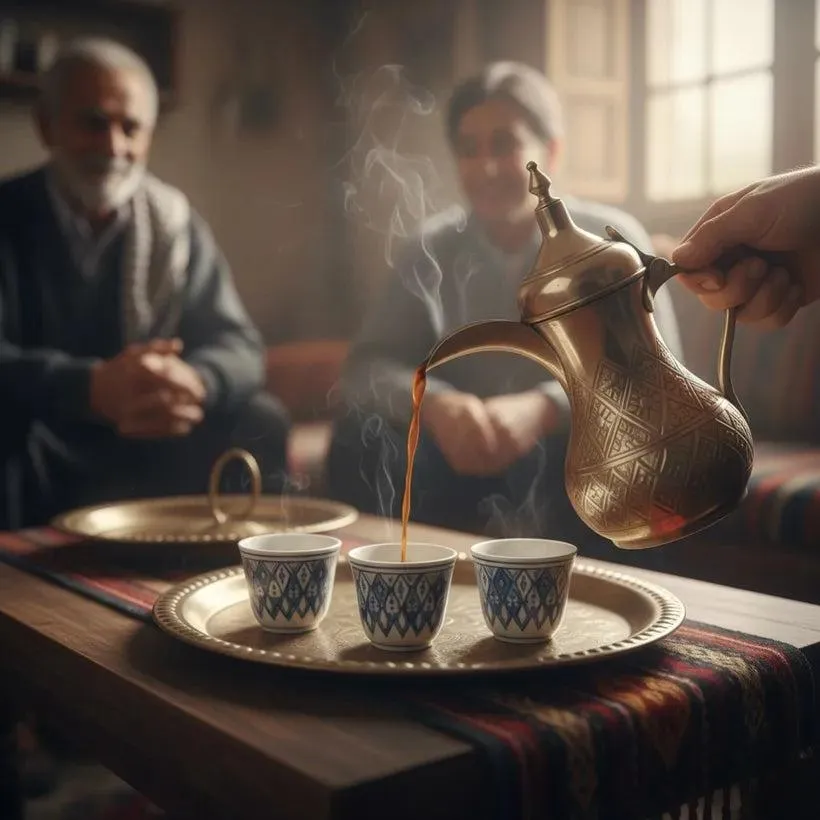
The objects associated with coffee can become part of the memory of a gathering: the pot brought out for visitors, the cups arranged on a tray, the familiar sound of coffee being poured, or the thermos kept ready when guests are expected.
A traditional dallah is one recognizable coffee pot across parts of the Arab world. Yet not every Palestinian household uses the same vessel. Depending on the style of coffee and family habits, coffee may be prepared in a different pot and poured directly into small cups.
The cup itself is often modest in size. A small serving makes it easy to offer coffee to several people and to refresh a guest's cup when appropriate. The host's attention—offering, pouring, and checking whether anyone would like more—is as important as the object used.
Etiquette can vary. Some Arabic coffee traditions include specific conventions about who is served first, how a guest signals they have finished, and how many cups are customary. These practices should be described in their own cultural settings rather than assumed to apply to every Palestinian gathering. If you are visiting someone, follow the host's lead; a polite question is always better than guessing at a rule.
Coffee Across Visits, Celebrations, and Difficult Moments
The meaning of coffee is shaped by the occasion.
An everyday visit
For an ordinary visit, coffee may offer a natural beginning to conversation. The exchange need not be elaborate: a cup, a place to sit, and time to listen can be enough. In many homes, coffee and tea are both familiar options, and the host may ask which a visitor prefers.
Family gatherings and celebrations
Coffee can accompany family visits and celebrations, giving people a shared moment before or after a meal. The preparation may be familiar to several generations, while the exact recipe and way of serving remain particular to a household.
Weddings and other milestones
Coffee appears in accounts of Palestinian celebrations, including weddings. The details can differ between families and communities, so it is best to avoid claiming that one coffee ritual is followed everywhere. A meaningful account should identify the specific practice and where it has been documented.
Mourning and remembrance
Coffee may also be served in somber settings. The Palestinian Heritage Trail notes that coffee offered to a neighbor in the morning has a different social meaning from coffee served at a funeral. In such moments, the act of offering a drink can be part of receiving visitors and sharing time with those who have come to express their condolences.
These examples show why context matters. Coffee does not carry one unchanging meaning; its significance is made through the people, place, and occasion.
What Coffee Can Tell Us About Living Heritage
Heritage is sometimes presented as something preserved behind glass, separated from everyday life. Coffee offers a more intimate view. Knowledge can pass from one generation to another through watching a family member prepare a pot, learning how much cardamom a relative prefers, or remembering how a particular gathering felt.
A recipe may change as ingredients, tools, schedules, and tastes change. Someone may use a thermos instead of serving directly from the pot; another household may prefer a different style of coffee. Such changes do not automatically erase a tradition. They are part of the way people adapt familiar practices to their lives.
For readers encountering Palestinian culture from outside the community, it is worth resisting the idea that an old-fashioned pot or a single recipe can stand for everyone. Palestinian culture is lived by people in different towns and villages, across generations and in diaspora communities. Everyday details—what is served, when it is offered, and who remembers preparing it—can tell a more grounded story than a sweeping claim about an entire culture.
How to Experience Palestinian Coffee Respectfully
If you are offered coffee in a Palestinian home or at a cultural gathering, the simplest approach is to receive the gesture warmly and follow your host's lead.
- Ask what is being served. It is fine to ask whether the coffee is Arabic or Turkish-style, or whether it contains cardamom or sugar.
- Let the host guide the etiquette. Serving customs vary, so observe what others do rather than assuming one rule applies everywhere.
- Listen to the story behind the recipe. A family member may have a memory or method that matters more to them than a formal description of the tradition.
- Avoid treating one account as universal. If you share what you learned, explain who told the story and in what context.
- Respect personal preferences. Not everyone drinks coffee, and hospitality can be expressed in many ways.
These small acts of attention help keep cultural exchange human rather than turning a living practice into a checklist of symbols.
Frequently Asked Questions
What is Palestinian Arabic coffee?
It commonly refers to a small serving of Arabic-style coffee, often flavored with cardamom. Turkish-style coffee is also common in Palestinian life, and recipes differ between households.
Why is coffee offered to guests in Palestine?
Offering coffee is a familiar gesture of welcome and hospitality. Depending on the context, it can accompany an everyday visit, a family gathering, a celebration, or a period of mourning.
Is Palestinian Arabic coffee always unsweetened?
It is often served without sugar, but not every household prepares it the same way. The style of coffee and the preferences of the people drinking it can affect the recipe.
Is Palestinian coffee the same as Turkish coffee?
No, not necessarily. Arabic coffee is often flavored with cardamom and served in small quantities; Turkish-style coffee is usually brewed with very finely ground beans in a small pot. Both can be found in Palestinian contexts.
Does every Palestinian family follow the same coffee etiquette?
No. Practices vary by family, place, generation, and occasion. Rules documented for one community or for Arabic coffee in another country should not automatically be applied to every Palestinian household.
What is the role of cardamom in Palestinian coffee?
Cardamom is a familiar flavoring in many descriptions of Palestinian Arabic coffee. The amount and timing of its addition depend on the recipe, and some coffee preparations use different methods or ingredients.
A Small Cup, a Shared Moment
A cup of coffee can be ordinary and meaningful at once. It may welcome a visitor, bring relatives into conversation, or accompany people through a celebration or a difficult day. Its significance lies not only in the beans, the pot, or the recipe, but in the relationships around it.
To understand Palestinian coffee, start with the people who prepare and share it. Listen to their memories, notice the differences between households, and let a specific story remain specific. That is one way to appreciate heritage as something lived and passed on—not simply displayed.
Continue exploring Palestinian food and cultural traditions with our Palestinian Pantry Guide, our guide to the Palestinian olive harvest, and our introduction to meaningful Palestinian gifts.
Sources and Further Reading
- Palestinian Heritage Trail — Palestinian Cuisine: contextual information about coffee and its social meaning in Palestinian life.
- American University of Beirut Libraries — “Palestinian coffee made by Rayya al-Mustafa”: an oral-history video describing one woman's memory of preparing coffee in Ramallah.
- The New Arab — “An A-Z guide for a cup of coffee in Gaza”: reporting on coffee preparation, everyday life, and the coffee trade in Gaza.
- Birzeit University — “Why Study in Palestine” guide: a general introduction to Palestinian hospitality and the offering of coffee or tea to visitors.
- UNESCO — “Arabic coffee, a symbol of generosity”: documentation of Arabic coffee traditions in the countries included in the UNESCO inscription; used here for regional context, not as evidence that every described practice is Palestinian.