Quick answer: Meaningful Palestinian gifts for children do not have to be expensive or complicated. A picture book by a Palestinian writer, a traditional game learned from a relative, a creative activity inspired by tatreez (تطريز), or a story shared by a grandparent can introduce Palestinian culture through reading, play, and everyday family experiences.
1. Why Cultural Gifts Matter in Childhood
A gift can do more than entertain a child. It can open a conversation, introduce a new word, inspire a question, or create a memory shared between generations.
For Palestinian families, especially those living outside Palestine, cultural gifts can give children approachable ways to explore family history and identity. A story about a grandmother, a book about a familiar landscape, or a game remembered by an older relative can make cultural knowledge part of ordinary life.
The most useful approach is to let children discover rather than simply memorize. A child who asks how olives become oil, why a family keeps an embroidered dress, or what a grandparent played in the street is already taking part in cultural learning.
There is no single way to introduce Palestinian heritage. Experiences differ between regions, towns, villages, families, generations, and diaspora communities. A thoughtful gift makes room for that diversity.
Four useful starting points are reading, playing, creating, and connecting with family memories.
2. Palestinian Children’s Books: Stories That Travel Between Generations
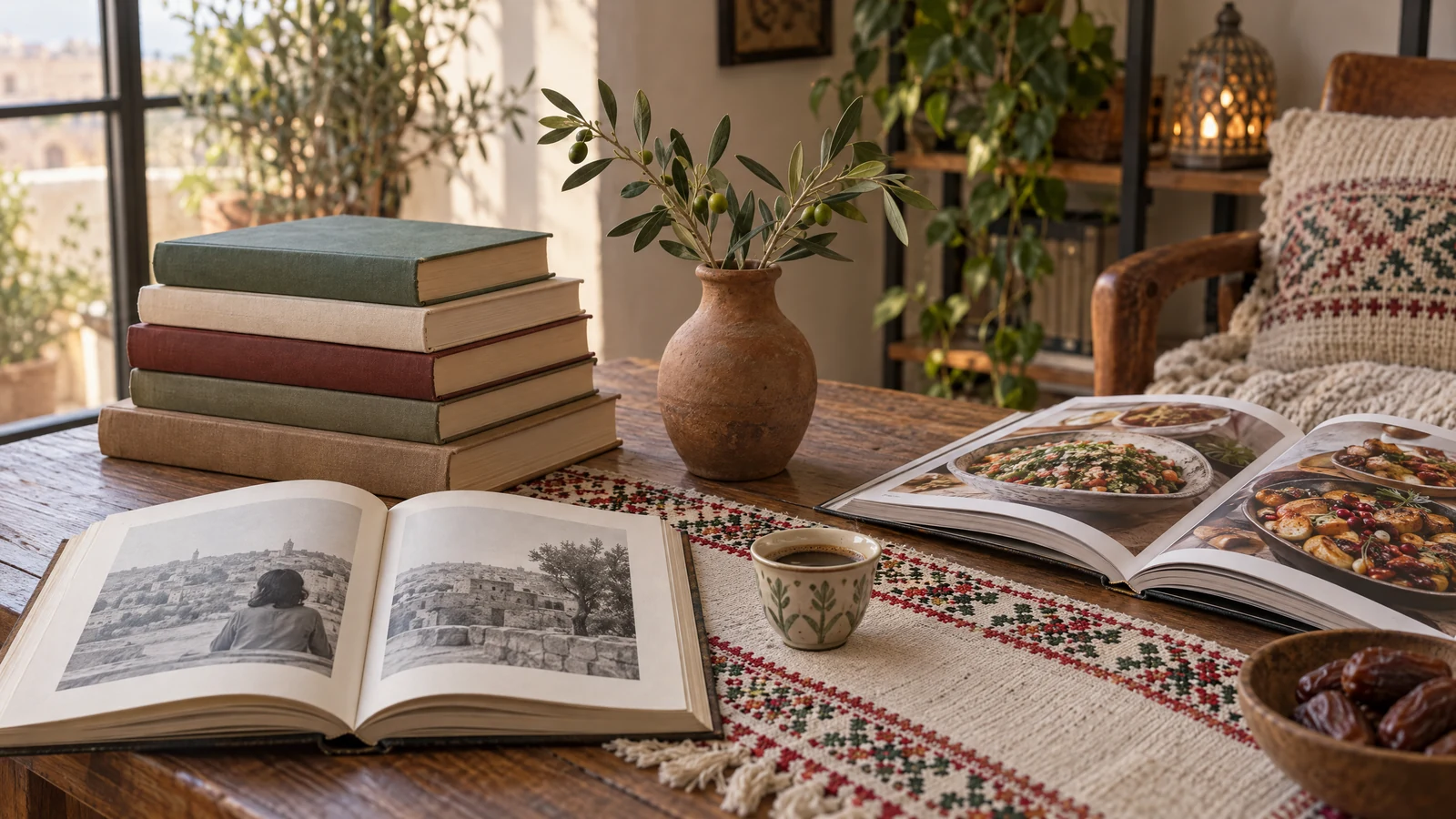
Books are among the most lasting Palestinian cultural gifts for children. They can introduce places, landscapes, food, family relationships, language, and the experiences of Palestinian children in different parts of the world.
The international collection Children’s Books from and about Palestine, curated through IBBY, is a useful starting point. It brings together titles by Palestinian authors and illustrators, as well as books about Palestinian experiences published by different publishers. The examples below are selected for their clear Palestinian cultural or family context; availability and editions vary by market.
A few examples include:
A Map for Falasteen: A Palestinian Child’s Search for Home
Written by Maysa Odeh and illustrated by Aliaa Betawi, this picture book follows a child who questions why Palestine does not appear on her map. Her family helps her understand the question, and her grandfather draws a map for her to share with her teacher and friends. The book offers a starting point for conversations about geography, family knowledge, and belonging.
Saeed & The Special Keffiyeh
Written by Dana Al-Husseini and illustrated by Heba Kwaik, this picture book follows Saeed on an imaginative adventure in which the keffiyeh (كوفية) twists and transforms into different forms. The IBBY listing identifies the 2025 edition from Zingo Ringo Books. It can prompt a conversation about clothing, patterns, and the ways cultural objects become part of family life.
Upside-Down Iftar
Written by Maysa Odeh and illustrated by Nadine Issa, this 2026 picture book follows Malak and her grandmother as they prepare iftar for their family. Its story uses maqluba (مقلوبة) and the shared preparation of a meal to celebrate Palestinian culinary culture. Check the publisher and edition details when purchasing, as availability may vary by country.
Sitti’s Secrets
Written by Naomi Shihab Nye and illustrated by Nancy Carpenter, this picture book tells of Mona’s visit to her grandmother, Sitti, who lives in a small Palestinian village. The publisher describes how the two communicate and learn about each other’s worlds despite the distance and language difference. It is a gentle starting point for talking about grandparents, family connection, and distance.
How to choose a book: Check the publisher’s description, language, reading level, edition, and availability. Do not assume that every book about Palestine is suitable for every age or that every title is available in Arabic and English. Choose according to the child’s reading ability and interests.
For more reading ideas, explore our Essential Palestinian Books Guide.
3. Traditional Palestinian Games: Heritage Through Play
Some traditional games use simple objects such as small stones, a ball, chalk, or a piece of rope. They can be introduced without expensive equipment and adapted to a safe space and the children’s abilities.
Accounts of Palestinian popular games document examples such as al-hajleh (الحجلة), or hopscotch, jump rope, and al-sab‘ hijar (السبع حجارة), the seven-stones game. Names and rules can vary between communities. That variation is part of how games are remembered and passed on.
Seven Stones
The seven-stones game uses a small stack of stones and a ball. In a commonly documented version, players divide into two teams. One team tries to knock down the stack with the ball and rebuild it, while the other team tries to prevent them.
For children, the game can introduce teamwork, coordination, movement, and shared rules. Use soft play equipment where appropriate, choose a safe open space, and adapt the rules to the children’s ages.
Hopscotch
Al-hajleh is a hopping game played on a marked ground surface. Draw a simple grid with chalk and invite children to take turns moving through it according to agreed rules.
A parent or grandparent can explain the version they remember. Children can also invent a variation while learning the name and family story associated with the game.
Small-Stone Games
Other traditional games use small stones and require players to throw, catch, arrange, or move them according to agreed rules. For indoor play, use larger, age-appropriate pieces and supervise young children to avoid choking hazards.
A traditional game is more than a set of instructions. It may carry expressions, songs, jokes, and memories. Ask an older relative what they played as a child, what they called the game, and who taught them. The conversation can be as meaningful as the game itself.
4. Tatreez and Creative Heritage Activities
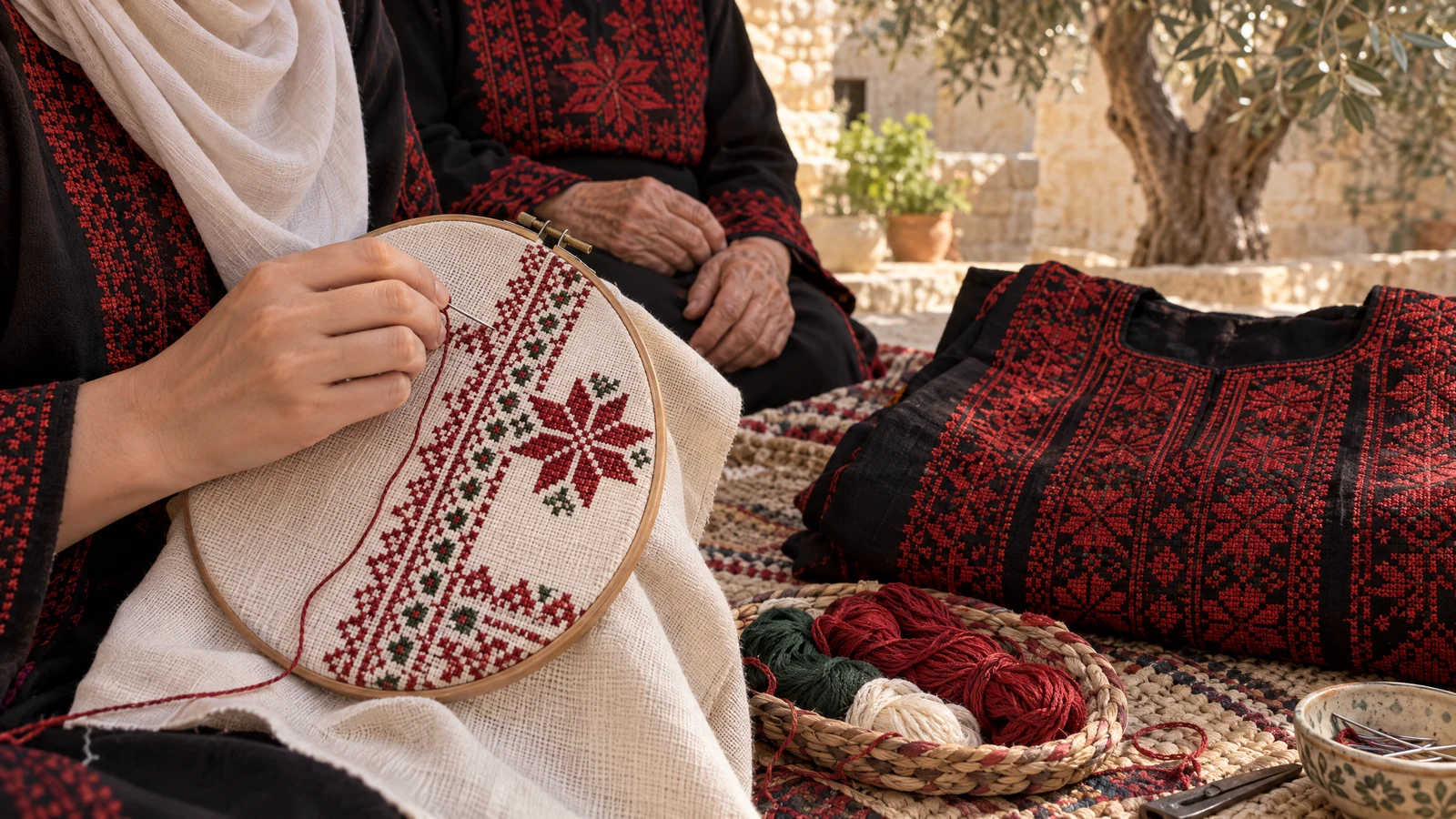
Tatreez (تطريز), Palestinian embroidery, offers a way to introduce children to patterns, colour, textiles, and regional differences.
The Palestinian Museum has developed educational resources to help children explore art, culture, and history. Its educational work has included stories, guides, interactive games, and other learning materials. The museum’s older Kids page also documents examples such as an embroidery colouring book and a matching game introducing motifs associated with different areas of Palestine. The page is marked as containing outdated information, so these examples should be understood as documented educational activities, not as products confirmed to be currently available for purchase.
Start With Pattern Observation
Show children photographs or illustrations of Palestinian embroidered garments. Invite them to notice repeated shapes, lines, colours, and borders.
Ask simple questions:
- Which shapes appear more than once?
- Where do you see repeated patterns?
- How are the colours arranged?
- What looks different between these examples?
Explain that Palestinian embroidery has regional and historical variations. Avoid telling children that every motif has one fixed meaning. A pattern’s name or interpretation may depend on its local context, period, and the person describing it.
Make a Paper Tatreez Activity
For younger children, draw a simple grid and let them create repeated geometric patterns using coloured pencils or paper shapes.
For older children, introduce a basic cross-stitch activity using suitable fabric and blunt tapestry needles under adult supervision.
The purpose is not to reproduce an intricate traditional garment in one sitting. It is to develop curiosity about the skill, patience, and creativity involved in embroidery.
Create a Heritage Colouring Book
A small handmade booklet can include drawings of embroidered patterns, traditional dress details, olive branches, local plants, and architectural features. Each page can include the Arabic name of the object alongside its English translation.
Children can colour the illustrations and add their own questions or observations. For more background, visit our guides to What Is Tatreez?.
5. Food, Family Stories, and Everyday Traditions
Not every cultural gift needs to be a purchased object. Sometimes the most memorable experience is something a child makes or discovers with family.
A simple cooking activity can introduce Palestinian food traditions through ingredients, smells, and shared work. Children might help wash herbs, arrange ingredients, prepare a salad, or learn the names of foods in Arabic and English.
A family can also create a small food-and-memory notebook. Each page might include:
- The name of a dish in Arabic and English.
- A photograph or drawing of the finished food.
- The name of the relative who introduced it.
- A short family memory connected to the dish.
- A note about how the recipe changes between households.
Za’atar (زعتر), olive oil, and bread can become the beginning of a conversation about everyday meals. Maqluba can introduce the idea of cooking together and sharing a family dish.
Our Palestinian Pantry Guide offers more background on ingredients and food traditions.
Family storytelling can be just as simple. Ask a grandparent to describe a childhood game, a favourite tree, a school memory, or a journey to a familiar market. Record the story, write it down, or let the child illustrate it.
The aim is not to turn every family memory into a formal history lesson. It is to make room for stories that might otherwise be forgotten.
6. Choosing Gifts by Age and Interest
A useful gift should suit the child who receives it. Reading ability, language, interests, and practical safety all matter.
| Child’s interests | Gift idea | A way to extend the experience |
|---|---|---|
| Enjoys picture books | Illustrated Palestinian storybook | Read together and discuss the illustrations |
| Likes puzzles and matching | Cultural or nature-based card game | Learn Arabic and English names |
| Enjoys drawing | Heritage colouring or pattern booklet | Create a personal illustrated notebook |
| Likes active play | Traditional outdoor games | Ask relatives to teach their version |
| Enjoys making things | Supervised beginner embroidery activity | Explore patterns and textile history |
| Loves family activities | Recipe or family-story notebook | Collect memories from older relatives |
These are activity suggestions, not fixed age recommendations. Always check the publisher’s guidance and the materials used in a craft or game before giving it to a child.
7. Helping Children Connect With Palestine Across Generations
For Palestinian children growing up abroad, cultural learning often happens through small repeated experiences rather than one special occasion.
A book read before bedtime, a family recipe prepared together, a video call with a grandparent, or a traditional game played during a family gathering can gradually build familiarity.
Families can create a simple monthly tradition:
- Read: Choose one Palestinian story and read it together.
- Play: Learn one traditional game from a relative or a documented source.
- Create: Draw a pattern, make a small craft, or build a family memory page.
- Share: Ask an older family member to tell a story, explain a word, or describe a place they remember.
Children should also be free to ask questions, imagine, and make their own connections. Cultural identity develops through relationships, experiences, and the freedom to explore.
8. How to Choose a Thoughtful and Respectful Gift
When buying a Palestinian cultural gift for a child, consider both its educational value and its origin.
A book should identify its author, illustrator, and publisher. A handmade object should explain who made it and where it was produced, when that information is available. A craft activity should use suitable materials and provide clear instructions.
A few useful questions can help:
- Does the gift introduce a real aspect of Palestinian culture or simply use a decorative Palestinian-inspired design?
- Is its origin or maker clearly identified?
- Is the language appropriate for the child?
- Can the child use, read, play with, or learn from it?
- Are any historical or cultural claims supported by reliable information?
A gift does not need to represent all of Palestine. A well-chosen book about one family, one place, one craft, or one tradition can be more meaningful than a generic object covered in cultural symbols.
For further guidance, read our Meaningful Palestinian Gifts Guide.
Frequently Asked Questions
What are good Palestinian gifts for children?
Picture books by Palestinian writers, traditional games, creative activities inspired by tatreez, and family storytelling projects are thoughtful choices. Consider the child’s interests, language, and reading level before choosing.
Where can I find Palestinian children’s books?
The IBBY collection Children’s Books from and about Palestine is a useful starting point. It lists books by Palestinian authors and illustrators, with publication details for many titles.
How can children learn Palestinian tatreez?
Begin with pictures of traditional dress and embroidery. Children can explore shapes and colours through drawing and matching activities before trying supervised stitching with appropriate materials.
What traditional Palestinian games can children play?
Documented examples include hopscotch, jump rope, and seven stones. Names and rules can vary, so learning a family or community version is a valuable part of the experience.
How can parents teach Palestinian heritage to children abroad?
Combine books, family photographs, recipes, songs, stories from older relatives, and creative activities. Regular experiences make cultural learning a natural part of family life.
A gift can become a story that stays. A book can be read again, a game can be taught to another generation, and a family memory can become part of a child’s own understanding of where they come from. The most meaningful Palestinian gifts for children are often the ones that invite them to ask questions, make things, and share experiences with the people they love.