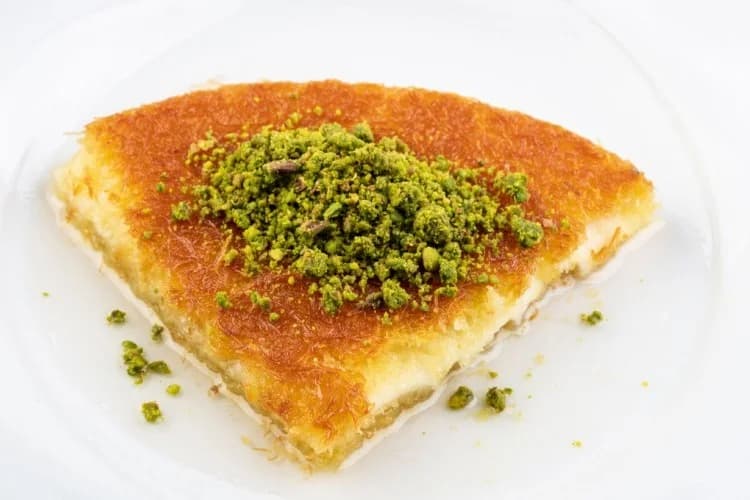
Quick answer: Knafeh (كنافة) is a traditional Middle Eastern dessert made with pastry, a filling, and sugar syrup. Palestinian knafeh Nabulsi is especially associated with Nablus and its white brined cheese. Other Palestinian versions, including a well-known Gazan style, use different fillings. Dubai chocolate borrows the crunch of kataifi pastry and the flavor of pistachio, but it is a chocolate bar, not knafeh.
What Is Knafeh?
Knafeh brings together pastry, a filling, and sugar syrup. Depending on the recipe, the pastry may be shredded kataifi (also called kadayif) or a fine semolina dough. In many Palestinian cheese versions, the pastry is mixed with ghee or melted butter, layered with cheese, baked until crisp, then finished with syrup known as ater.
In Palestine, knafeh is often shared at celebrations and milestones, from graduations to a new home. In Falastin, Sami Tamimi and Tara Wigley describe it as “a Palestinian institution”, closely tied to hospitality and celebration.
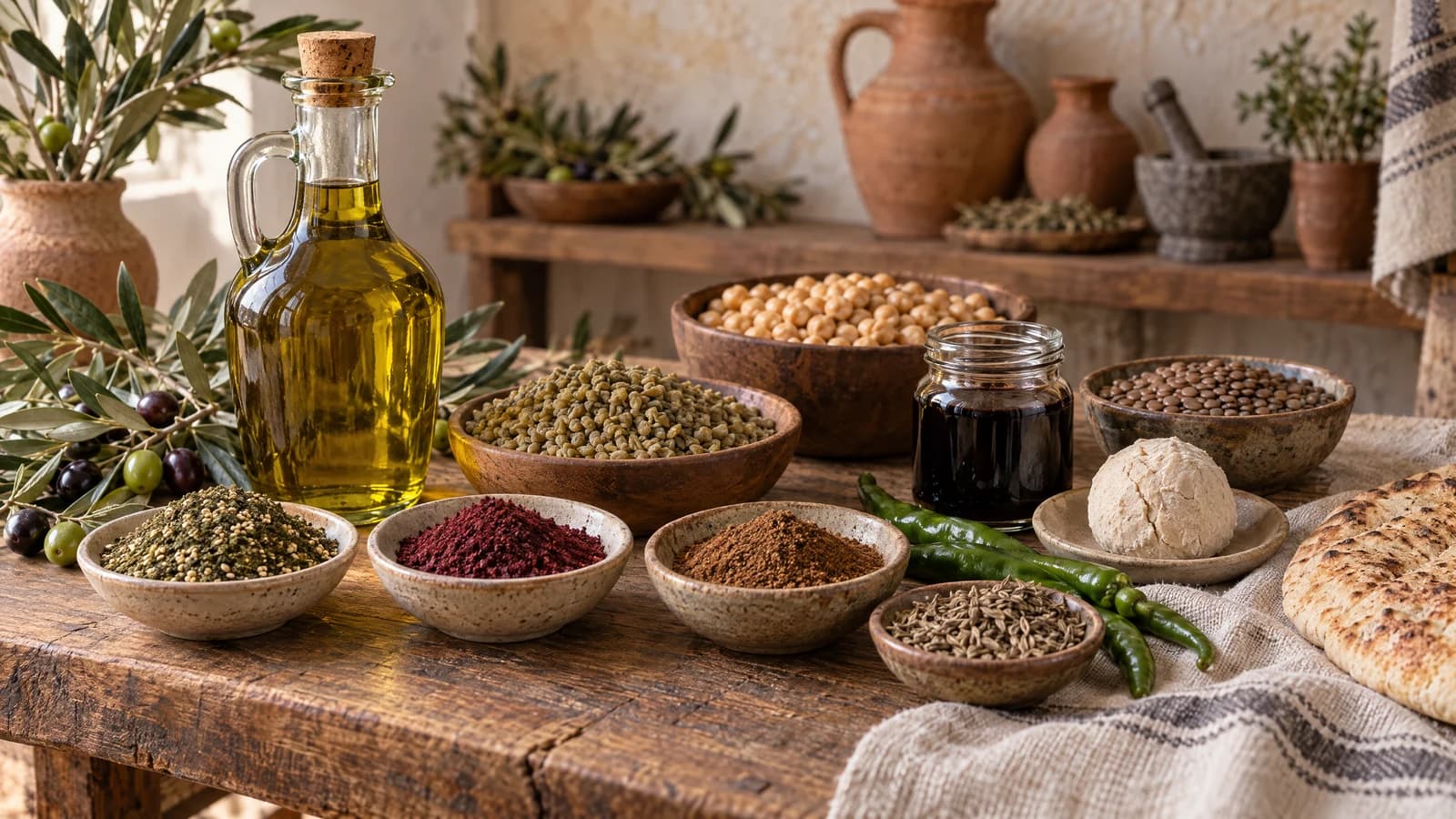
The name appears in several spellings, including knafeh, kunafa, kunafeh, and künefe. The recipes are just as varied. For more on ingredients used in Palestinian cooking, see the Palestinian pantry guide.
Palestinian Knafeh: Nablus and Gaza
Knafeh Nabulsi. Nablus is the city most closely associated with Palestinian cheese knafeh. In their Guardian recipe, Sami Tamimi and Tara Wigley describe the local cheese as firm, white, and salty. In a 2015 report from Nablus, Ilan Ben Zion describes a semolina-based version cooked until crisp on one side, with cheese melting beneath it and syrup added at the end. Recipes differ between bakeries and families, but toasted pastry, stretchy cheese, and syrup are central to the best-known Nabulsi style.
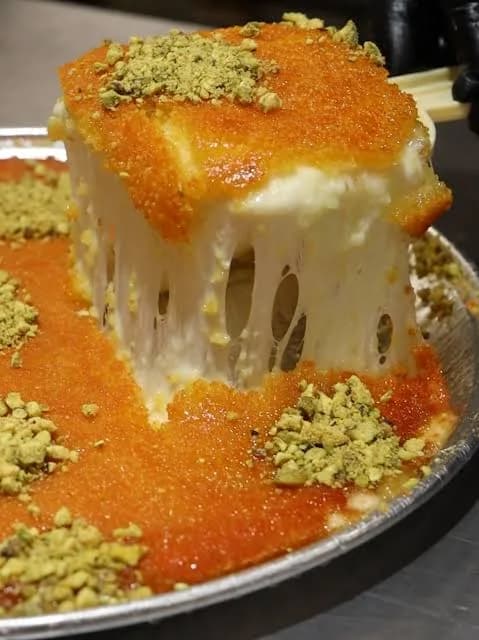
The cheese-filled Nabulsi style is best served warm, while the cheese is still soft.
A well-known Gazan variation. Not all Palestinian knafeh contains cheese. BBC Travel’s 2017 report describes knafa Arabiya or Ghazawiya, a Gaza version filled with nuts and flavored with spices such as cinnamon and nutmeg. At Saqallah’s Sweets in Gaza City, the version described in the report used toasted ground semolina, whey, and milk, topped with walnuts and spices. The article reported that the shop had been making the dessert since 1896; its present status is not confirmed here. Home recipes can differ, with some using a mixture of bulgur and semolina.
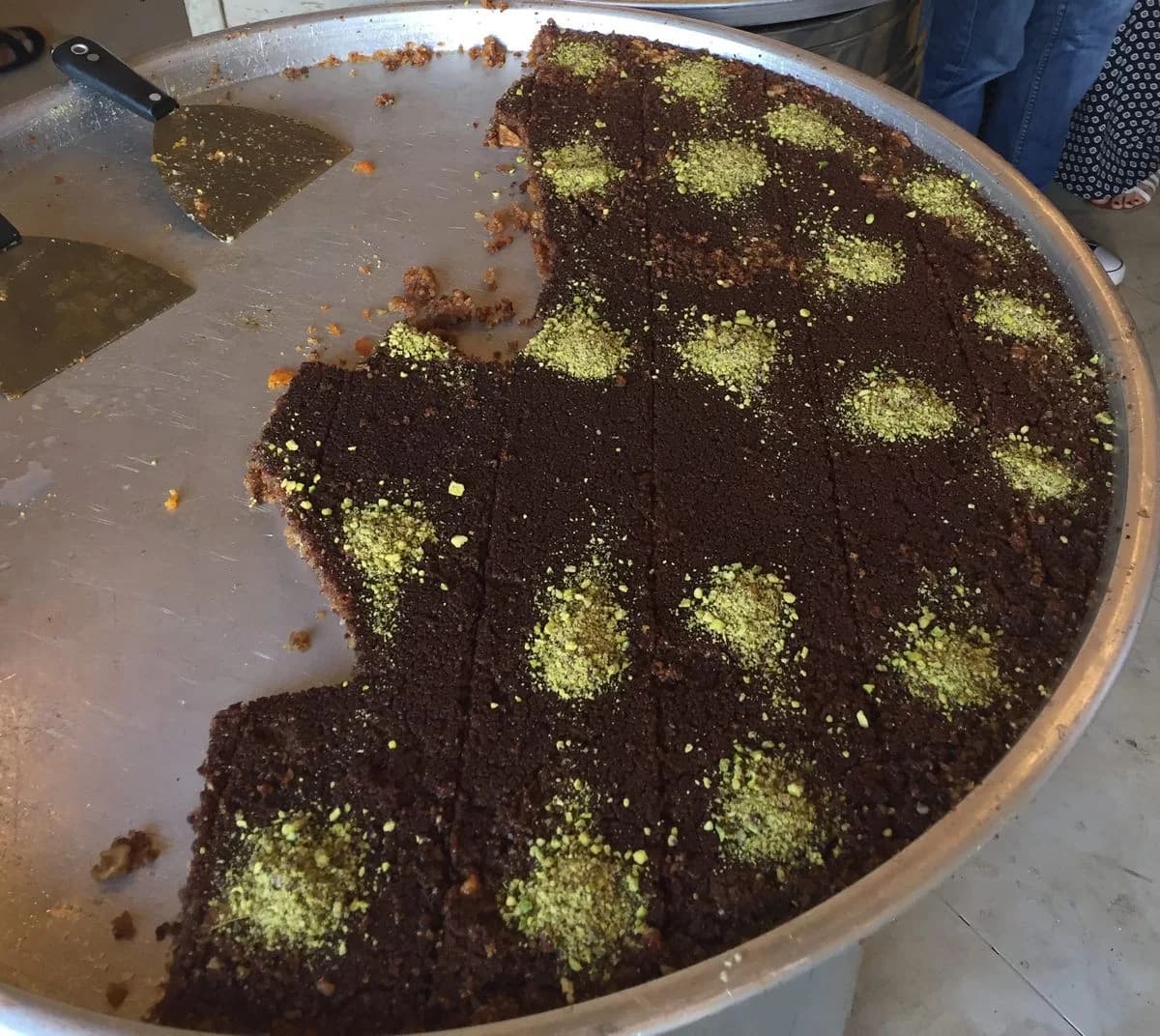
Gazan knafeh Arabiyeh is known for its nut-and-spice filling rather than the cheese used in knafeh Nabulsi.
Tamimi and Wigley also describe knafeh Arabiyeh with a nut-and-cinnamon filling, and Palestine in a Dish includes a walnut version called knafeh bil joz.
Nablus’s association with knafeh is strong, especially in the story of the cheese-filled version. That does not establish that every form of knafeh began there. As The Economist noted in 2018, the evidence for a single place of origin is not conclusive.
Nabulsi Cheese
Nabulsi is a Palestinian white brined cheese named after Nablus. A 2011 Journal of Dairy Science study describes it as a semi-hard, high-salt cheese made without a starter culture. The curd is pressed, cut into blocks, boiled in brine, and stored in brine. It softens and turns elastic when heated, which makes it suitable for knafeh.
The milk used can vary. The same study describes sheep’s or goat’s milk, or a blend of the two, as traditional, while cow’s milk and cow-and-sheep blends are also used in commercial production. Some makers flavor the brine with mahleb or mastic, though practices differ. If the milk or seasoning matters to you, ask the cheesemaker how that particular cheese is made.
Because the cheese is salty, it is usually soaked in fresh water before baking.
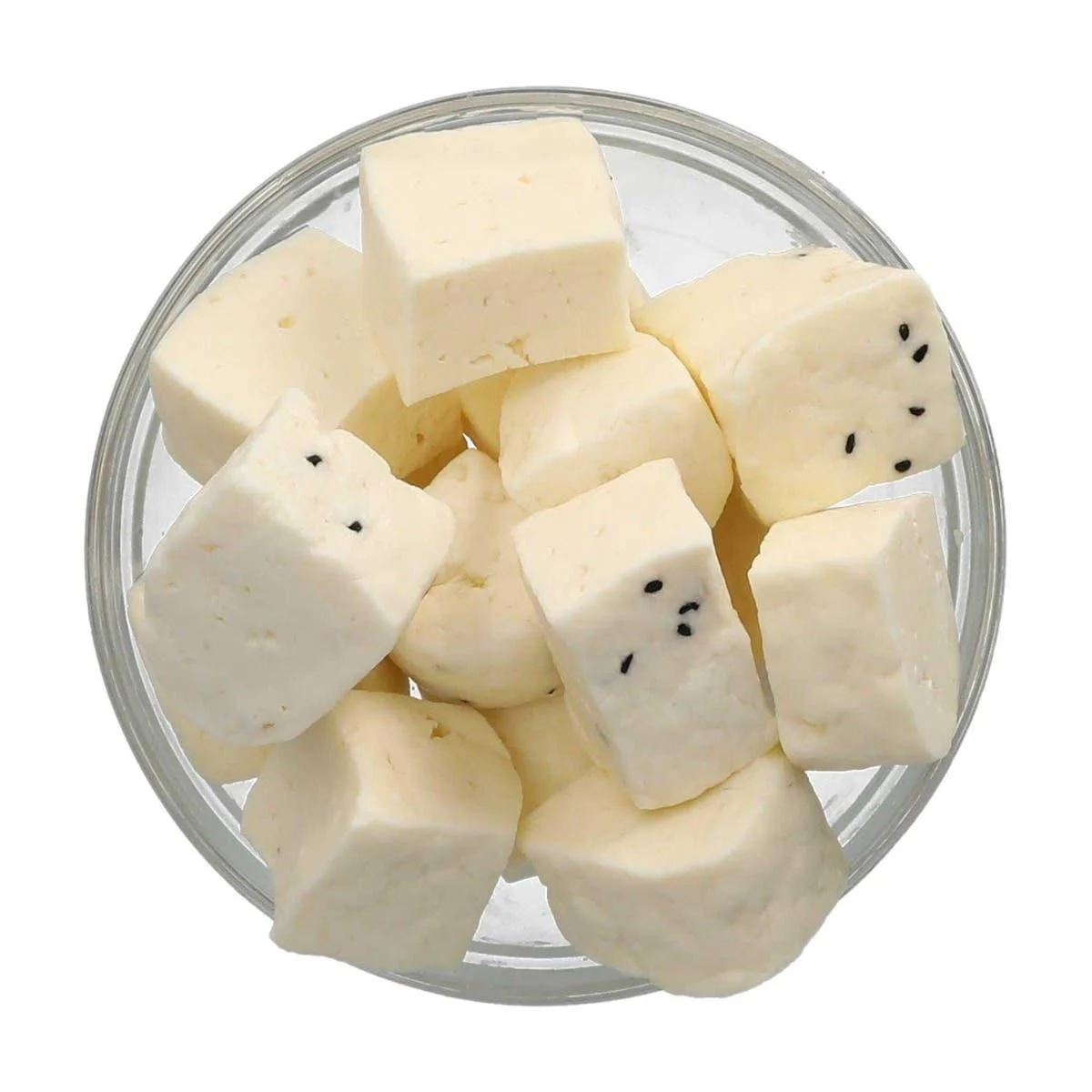
Soaking helps reduce the saltiness of brined cheese before it is used in the dessert. A study in Current Research in Nutrition and Food Science describes soaking to reduce the salt, and Palestine in a Dish includes the same step. Outside the region, cooks may use a mix of mozzarella and ricotta or other cheeses that melt well.
Food historian Dima Sharif takes a stricter view. In a 2020 podcast, she argues that traditional Nabulsi cheese should combine sheep’s and goat’s milk and questions whether versions made with cow’s milk meet that standard. This is her view; milk types used in commercial production vary.
Regional Variations
Knafeh changes from place to place. Some versions use long, shredded pastry; others use a finer semolina dough. The filling may be cheese, nuts, or cream, and the syrup and finishing touches vary too.
In Turkey, Antakya Künefesi is a regional cheese pastry with a protected geographical indication. Its name was registered by Turkey in 2008 and entered the European Union’s register of protected geographical indications in 2023. The protection applies to the named regional product, rather than to every form of knafeh.
For Palestinian readers, the most useful distinction here is between the cheese-filled Nabulsi style and the nut-and-spice Gazan variation.
Where Does Knafeh Come From?
Knafeh’s history is difficult to trace to a single place or moment. Stories link the dessert to Fatimid Egypt or Umayyad Damascus, including a tale about a ruler who needed food during Ramadan. These stories are part of the dish’s history, but they do not establish a definitive origin. The Economist has reviewed some of these competing accounts.
In a Deep Fried podcast, food historian Mary Işın says that the 18th-century recipes she has studied use nuts rather than cheese. She raises the possibility that cheese-filled knafeh developed later, while making clear that its precise origin is uncertain.
A Beirut cookbook published in 1885, Khalil Sarkis’s Tadhkirat al-Khawatin wa-Ustadh al-Tabbakhin, includes a recipe titled knafeh with cheese (الكنافة بالجبن). The digitized book is available through the Internet Archive. It documents a cheese-filled version by that date, but it cannot tell us exactly when or where the recipe first appeared. In the same podcast, food historian Dima Sharif argues that Nablus played a defining role in the development of the baked, cheese-filled knafeh known today. Knafeh has a long regional history, while knafeh Nabulsi is especially associated with Nablus and Palestinian food culture.
Knafeh and Dubai Chocolate
Dubai chocolate takes inspiration from knafeh, but it is a different product. *The New York Times reported that chocolatier Sarah Hamouda developed the bar after craving knafeh during pregnancy. The product, called “Can’t Get Knafeh of It,” combines a milk-chocolate shell with pistachio cream and crunchy kataifi pastry.
| Knafeh Nabulsi | Dubai chocolate | |
|---|---|---|
| Form | Baked pastry, served hot | Chocolate bar |
| Filling | Nabulsi cheese | Pistachio cream and kataifi |
| Finish | Sugar syrup | Chocolate shell |
| Association | Nablus, Palestine | Dubai, UAE |
The shared elements are the pastry’s crunch and the pistachio flavor. Knafeh itself remains a baked dessert finished with syrup.
How to Recognize Knafeh Nabulsi
- Ask about the cheese. Knafeh Nabulsi is defined by Nabulsi cheese, desalted before baking.
- Expect it hot. Cheese knafeh is usually served warm, while the cheese is still soft. The Palestine in a Dish recipe explains the preparation.
- Do not rely on color alone. A bright orange top is common in some shops, but color does not establish a pastry’s origin or ingredients.
- Look for the cheese-free alternative. Arabiyeh or Ghazawiya refers to the nut-and-spice style associated with Gaza.
Knafeh is often served with bitter coffee or unsweetened tea, which balances the sweetness of the syrup.
Key Terms
- Knafeh (كنافة): A dessert made with pastry, filling, and sugar syrup; also spelled kunafa, kunafeh, or künefe.
- Knafeh Nabulsi (كنافة نابلسية): The cheese-filled version associated with Nablus.
- Nabulsi cheese: A Palestinian white brined cheese named after Nablus.
- Kataifi / kadayif: Thin, thread-like pastry used in many versions of knafeh.
- Ater / qater: Sugar syrup poured over the finished pastry.
- Knafeh Arabiyeh / Ghazawiya: The nut-and-spice variation associated with Gaza.
Sources
- Sami Tamimi and Tara Wigley, “Knafeh nabulseyeh,” The Guardian, March 2021.
- Ilan Ben Zion, “A Trip to the West Bank’s Cheesy Dessert Capital,” VICE, August 2015.
- Miriam Berger, “The Palestinian dessert few can enjoy,” BBC Travel, August 2017.
- “Palestinian Knafeh Recipe,” Palestine in a Dish, November 2023.
- “Kunafa: Who Made It First?” Deep Fried podcast, Frying Pan Adventures, October 2020.
- Ella Hill, “Knafeh, the Levantine pudding fit for a prince,” The Economist (1843), April 2018.
- “Knafeh,” Encyclopaedia Britannica.
- M. Ayyash, F. Sherkat and N. Shah, “The effect of substituting NaCl with KCl on Nabulsi cheese,” Journal of Dairy Science, 2011.
- “Quality of White-Brined Nabulsi Cheese Made with Different Proportions of Sheep’s and Cows’ Milk,” Current Research in Nutrition and Food Science.
- Khalil Sarkis, Tadhkirat al-Khawatin wa-Ustadh al-Tabbakhin, Beirut, 1885.
- Commission Implementing Regulation (EU) 2023/562, “Antakya Künefesi” (PGI), March 2023.
- TÜRKPATENT, “Antakya Künefesi,” geographical indications portal.
- Korsha Wilson, “How Dubai Chocolate Took Over the World,” The New York Times, January 23, 2025.
What to Read Next
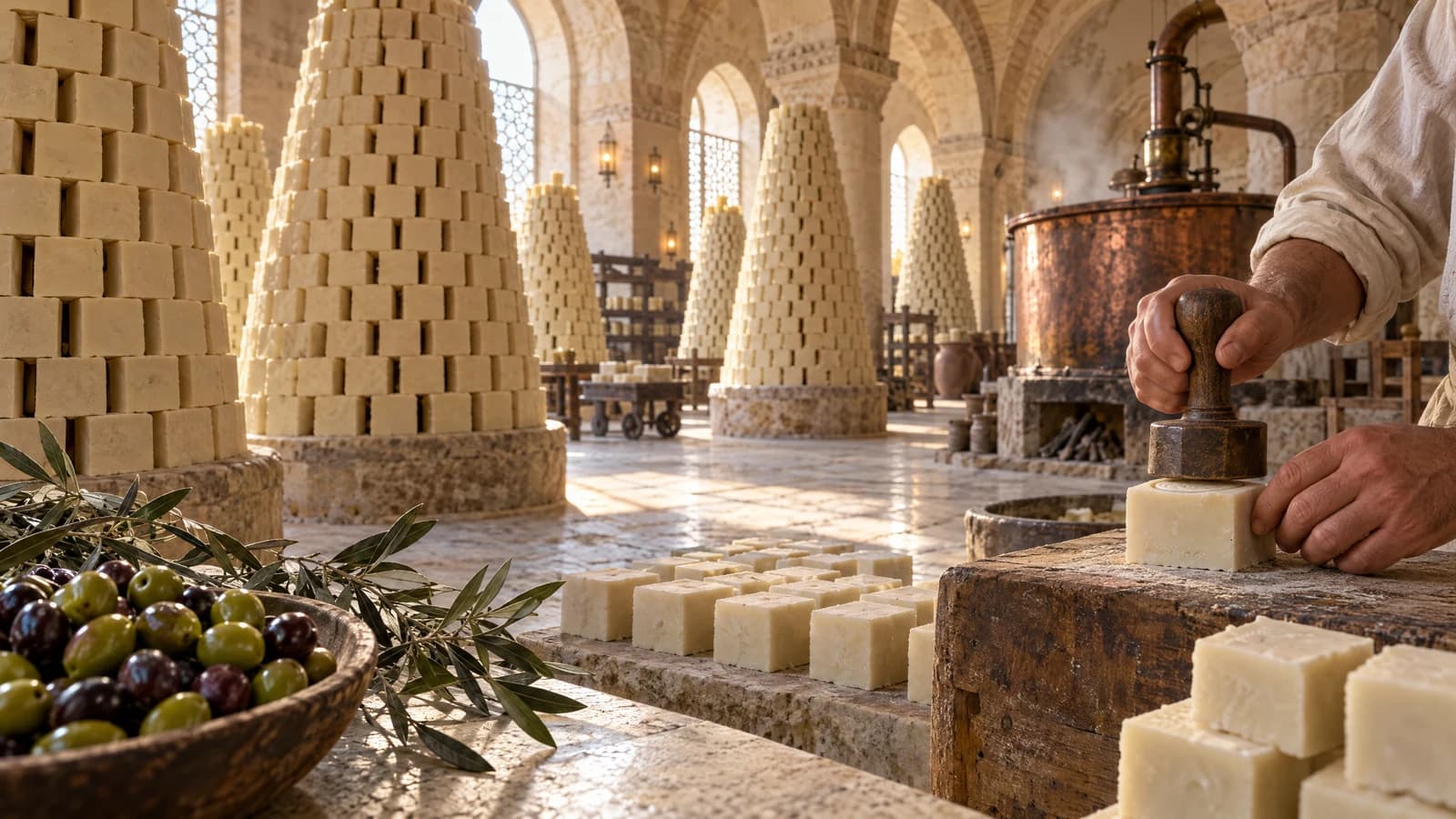
- Learn more about the city behind the dish: The 1,000-Year Chemistry and Craft of Nablus Olive Oil Soap.
- Stock the rest of the kitchen: The Palestinian Pantry Guide.
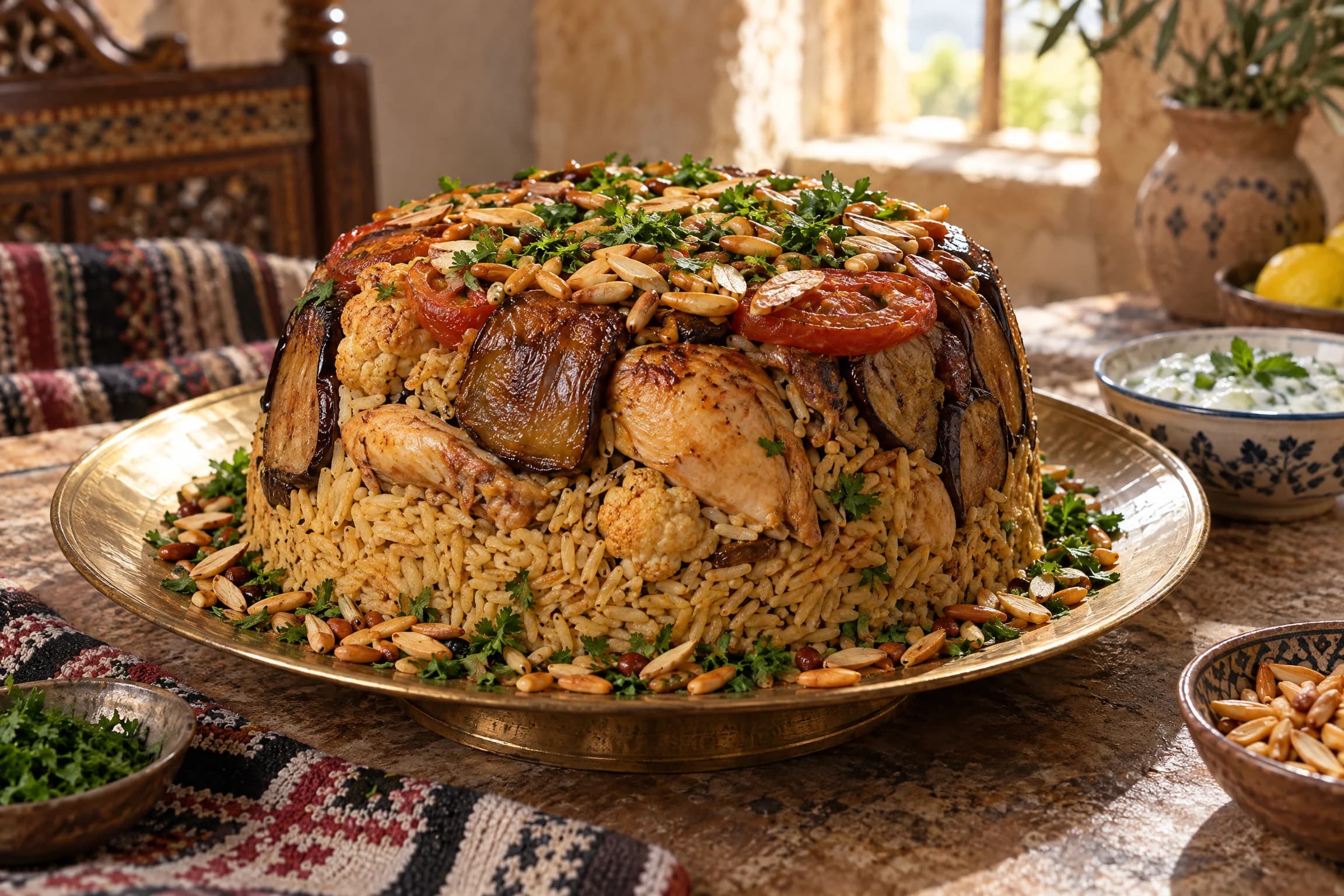
- Another dish that ends with a flip: Palestinian Maqluba Recipe: Technique, Aromatics & the Flip.
- Serve it with a traditional drink: Palestinian Arabic Coffee Traditions.