Traditional Palestinian Crafts Shaped by Material and Place
Palestinian craft history is not a single catalogue of decorative objects. It is a history of materials, workshops, household use, trade, and skills passed from one generation to the next. In Hebron, glassworkers transform a heated mass of glass into bowls, bottles, lamps, and other household pieces. In Gaza, potters prepare clay, shape it on a wheel, dry it, and fire it into vessels for cooking, storing water, preparing food, or decorating the home.
These traditions belong to different places and should not be merged into one undifferentiated story. Hebron glass depends on furnace heat, blowing, rotation, and the timing of cooling. Gaza pottery depends on clay preparation, moisture control, shaping, drying, and firing. Their connection is not that they are identical. It is that both make material knowledge visible: the finished object records the hands, tools, fuel, and local economy that produced it.
The evidence also calls for care. Family workshops often preserve their own histories, while archaeological research uses categories that do not always map neatly onto present-day craft practice. This article therefore distinguishes documented workshop accounts from broader historical interpretations.
What Is Hebron Glass? History and Family Workshop Traditions
Hebron Glassmaking and Inherited Artisan Skill
Hebron glass, often called zujaj al-Khalil (زجاج الخليل), is associated with hand-blown glass made in the city of Hebron. Contemporary workshop accounts describe the craft as a family practice taught through long apprenticeship. Cultural Survival’s profile of Hebron Glass, a Natsheh family business, reports that the business was established in 1890 and that family members learned the work from their fathers and grandfathers. The same profile says that apprentices may need years of practice before they can work independently. 1
These dates should be understood as the documented history of that workshop rather than proof that every stage of glassmaking in Hebron began in 1890. Other accounts place Hebron glass within a much older eastern Mediterranean glassmaking environment, but the precise chronology of local production is more complicated than a single founding date. A careful description is therefore stronger than an absolute origin claim: Hebron has a long glassworking tradition, and particular families preserve documented workshop lineages within it. 1 2
The craft is also tied to household life. Workshop descriptions mention bowls, plates, goblets, pitchers, vases, hanging pieces, lamps, ornaments, and beads. These objects can be decorative, but they are not only souvenirs. Glassware has been used in Palestinian homes and at celebrations, where the object’s value includes both its function and its connection to local making. 1 2
How Hebron Glass Is Made: Recycled Glass and Furnace Heat
The Hebron Glass workshop profiled by Cultural Survival uses recycled glass as a principal raw material. The report says the workshop collects broken bottles from local homes and businesses, while fuel for its furnaces may come from repurposed motor oil collected from local garages. This practice is practical as well as symbolic: it gives that workshop an accessible material stream and reduces dependence on newly imported glass inputs. 1
Recycled glass is not simply placed in a furnace and removed as a finished object. It must be heated until it becomes workable, then gathered and controlled on the end of a long metal blowpipe. The heat of the material determines how much time the craftsperson has to shape it. If the glass cools too quickly, it becomes difficult to move; if it remains too fluid, it may lose the form being built.
A workshop account describes the glass being fused at approximately 1,000°C until it becomes suitable for blowing. The artisan uses a long steel tool called a kammasha, reported in that account as roughly one to one and a half metres long. After shaping, the piece is moved to a nearby space for slow cooling. 1
The exact proportions, furnace settings, colour recipes, and shaping sequences are not universal. They may vary by workshop and product. This is one reason to avoid presenting “Hebron glass” as if every family uses one identical formula.
Hand-Blown Glass Colours and Forms from Hebron
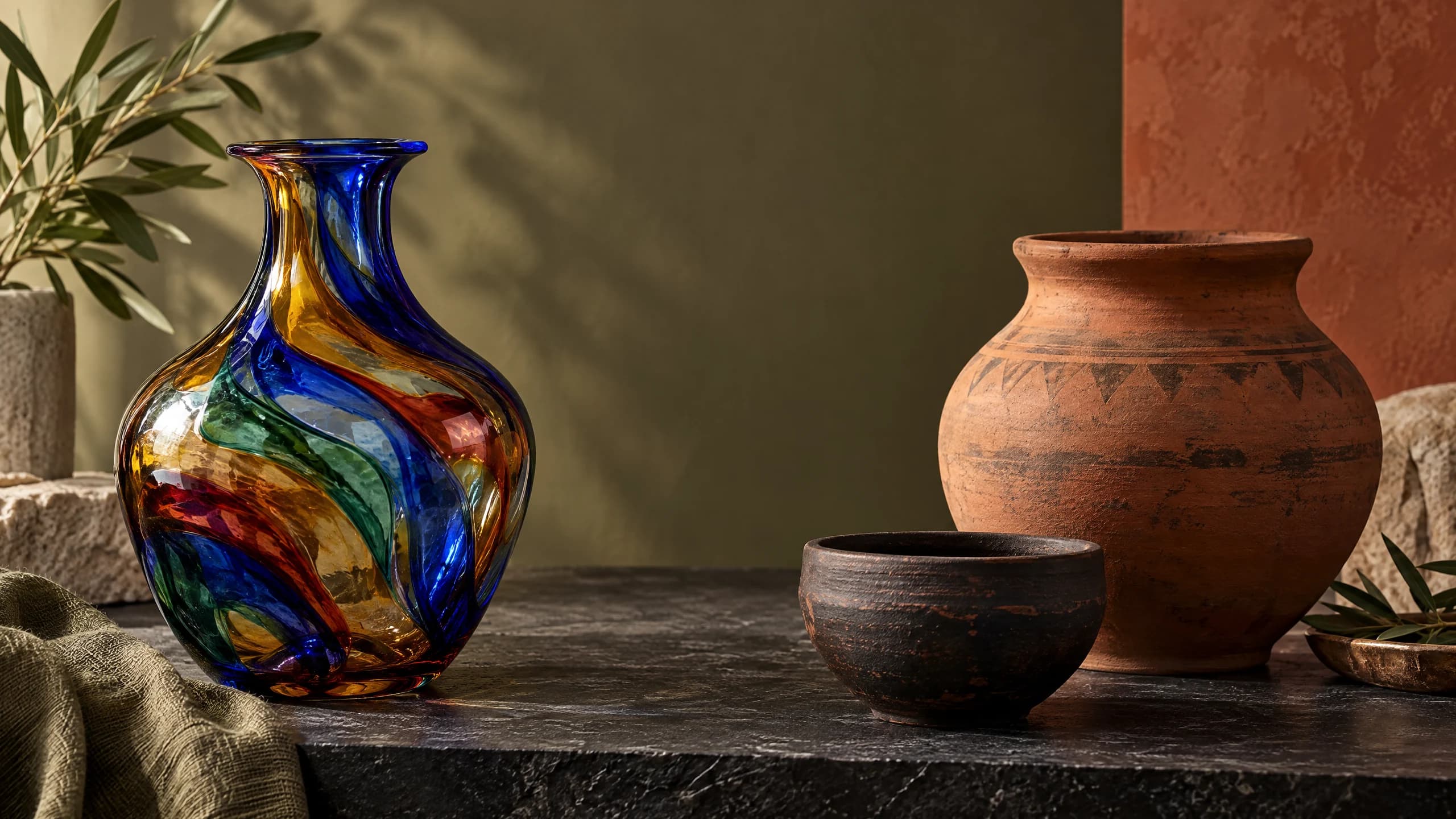
The visual character of Hebron glass often comes from translucent colour, visible swirls, and the irregularities that accompany hand shaping. Accounts of the craft describe reds, blues, greens, and ambers, as well as vessels and ornaments made in forms suited to the home. 1 2
Colour should not be treated as a fixed symbolic code unless a source documents a particular meaning. In many cases, the colour is part of the material and design language of the workshop rather than a universal message shared by every object. The most reliable way to describe a piece is to identify its form, material, maker, and documented use before assigning symbolic interpretation.
Hebron Glass as a Living Palestinian Craft
The survival of the craft depends on more than historical pride. Workshops need fuel, raw materials, skilled labour, customers, and routes through which goods can move. Cultural Survival reports that movement restrictions and the wider Israeli-Palestinian conflict have affected the industry. It also describes the workshop’s efforts to maintain work for artisans and to participate in fair-trade channels. 1
A 2015 report on the Natsheh family’s ceramics and glass factory described a business that had adapted to changing markets. When tourism declined during the Second Intifada, the factory pursued exports; the report said that, at that time, most of its ceramic production was sold abroad. This is a useful example of adaptation, but the figures belong to that report’s period and should not be presented as current market data without a new check. 3
What Is Gaza Pottery? Clay, Vessels, and Household Use
Gaza Ware and Contemporary Gaza Pottery: An Important Distinction
Pottery in Gaza belongs to both an archaeological record and a continuing workshop practice. These two histories are related, but they should not be collapsed into one claim.
In archaeological literature, “Gaza Ware” refers to a category of pottery associated with the southern Coastal Plain in Late Islamic and Ottoman contexts. A 2024 study describes it as a dark-coloured fabric with a wide range of vessel forms. The study also notes that the earliest appearance of this pottery remains debated, while proposing that some examples may date to the seventeenth or even sixteenth century. 5
This debate matters because a modern black pot made in Gaza is not automatically an archaeological Gaza Ware vessel. Archaeological categories depend on excavation context, form, fabric, and dating. Contemporary potters may preserve techniques, shapes, or material choices that resemble older traditions, but each present-day object must be described according to its own documented production context.
How Gaza Pottery Is Prepared: Clay, Water, and Kneading
A 2016 report from Gaza describes a family workshop that sourced clay from areas east of Jabalia and from other parts of the Strip. The clay was spread out to dry, placed in water to separate it from impurities, and then left to dry again in a large basin. Once it reached a workable consistency, it was kneaded in a machine before being divided into pieces for shaping. 4
This sequence shows why pottery begins long before the wheel. The potter must control the clay’s moisture and remove material that could weaken the vessel during firing. Clay that is too wet may collapse while being shaped. Clay that is too dry may crack or resist the movement of the hands. The preparation stage is therefore a technical part of the craft, not an invisible preliminary step.
How Gaza Pottery Is Shaped, Dried, and Fired
The same report describes vessels being shaped on a manually operated wheel, then placed in the open air to dry before entering a kiln. It gives a firing temperature of approximately 900°C for the workshop’s pottery. At that stage, the clay becomes a hard ceramic body that can serve as a cooking, storage, or household vessel. 4
The shapes reported from Gaza include bowls, cups, jugs, and other vessels for food and drink, alongside decorative pieces. The workshop account describes these vessels as part of everyday food and household use. That is evidence of continuing practical use in a particular workshop context, not proof that every Gaza pottery form has always served the same purpose. 4
Black Gaza Pottery and Firing Methods
The 2016 workshop account describes red and white as common pottery colours and identifies black pottery as a distinctive Gaza form. According to the account, the black colour is produced by closing the kiln after adding used oil or vehicle tyres, allowing the firing atmosphere to alter the surface colour. 4
This detail requires careful editorial handling. It is a report of a particular workshop method and should not be presented as the only way Gaza pottery becomes black. It also raises questions about fuel, smoke, worker safety, and environmental impact.
What Hebron Glass and Gaza Pottery Reveal Together
Palestinian Household Objects Made for Use
Hebron glass and Gaza pottery are often presented to outside audiences as decorative heritage. Their histories show a broader reality. Glass vessels have served the table, the home, and celebrations. Clay vessels have carried water, held food, supported cooking, and helped families manage daily life. Their beauty is inseparable from their use.
This distinction matters for ethical curation. A craft object should not be reduced to an exotic image or a generic “Palestinian style.” Readers deserve to know where the object was made, whether it is hand-blown or moulded, whether its materials are recycled, who produced it, and whether the seller can identify the workshop or cooperative.
Family Knowledge, Apprenticeship, and Economic Pressure
Both traditions depend on transmission. Glass requires controlled work near extreme heat, while pottery requires knowledge of clay, drying, wheel movement, kiln atmosphere, and firing time. These skills are learned through repetition and correction, not only through written instructions.
At the same time, transmission is vulnerable when workshops lose access to fuel, raw material, customers, transport, or safe working conditions. The Gaza report describes a sharp decline in the number of operating pottery factories compared with an earlier period. The Hebron sources describe market changes, movement restrictions, and the need to combine local sales with exports. 1 3 4
The responsible story is therefore neither romantic nor fatalistic. These crafts are not frozen remnants of the past, but neither are they guaranteed to survive simply because they are culturally important. They continue when people can make a living from them and when younger workers have a reason and a practical opportunity to learn.
How to Buy and Describe Palestinian Crafts Responsibly
When buying or documenting Hebron glass, ask for the workshop or maker’s name, the production location, and the intended use of the piece. For food-contact objects, ask whether the surface and pigments are suitable for that use. A handmade object may be beautiful without being designed for hot food, long-term liquid storage, or a dishwasher.
When buying Gaza pottery, ask whether the piece is intended for cooking, serving, water storage, or decoration. Do not assume that every vessel is food-safe simply because it is made from clay. Ask how it was fired, whether it is glazed, and whether the maker provides care instructions.
Most importantly, describe the object precisely. “Hand-blown glass from a Hebron workshop” is stronger than an unverified claim about ancient Phoenician origin. “Contemporary Gaza pottery made in a family workshop” is more accurate than calling every dark vessel an archaeological Gaza Ware artifact. Precision protects both the reader and the tradition.
A Living Palestinian Heritage of Fire and Clay
Hebron glass and Gaza pottery show two different ways that Palestinian material culture remains visible in the present. Glass carries the movement of heat, breath, and colour. Pottery carries the preparation of earth, water, pressure, drying, and fire. Both traditions turn ordinary materials into objects that can enter kitchens, homes, markets, and family memory.
Their future depends on practical support: fair payment, accurate attribution, safe materials, viable workshops, and opportunities for apprentices to learn. To appreciate these crafts is not only to admire their surfaces. It is to understand the labour and local knowledge inside them—and to describe that knowledge without claiming more than the evidence can support.
What to Read Next
- Continue with the wider map of Palestinian craft centres in Living Heritage: A Guide to Historic Palestinian Craft Guilds and Regional Traditions.
- Explore the coastal textile connection in The Weaving Heritage of Al-Majdal.
- Learn how olive oil connects food, agriculture, and craft in The 1,000-Year Chemistry and Craft of Nablus Olive Oil Soap.